On 25 August 2016 a symposium will be held in Wilhelmshaven, analysing the status of migratory birds on the East-Atlantic Flyway.
Trends in migratory bird numbers are showing an alarming decline for many bird populations in the Wadden Sea. It is not clear whether the causes of the observed declines are to be found in the Wadden Sea, somewhere else along the East Atlantic Flyway, or both.
Further information can be found on the webpage of the
Common Wadden Sea Secretariat.
Posted by Gregor Scheiffarth on 29 June 2016
On 25 August 2016 a symposium will be held in Wilhelmshaven, analysing the status of migratory birds on the East-Atlantic Flyway. Trends in migratory bird numbers are showing an alarming decline for many bird populations in the Wadden Sea. It is not clear whether the causes of the observed declines are to be found in the Wadden Sea, somewhere else along the East Atlantic Flyway, or both. Further information can be found on the webpage of the Common Wadden Sea Secretariat.
Posted by Silke Nebel on 15 June 2016
A new ABC/BBC series explores in 4 parts the monumental journey millions of shorebirds make between their breeding grounds in arctic tundra and their wintering grounds in Australasia. Episode I https://www.abc.net.au/radionational/programs/offtrack/flying-for-your-life-1/7461802 Episode II https://www.abc.net.au/radionational/programs/offtrack/flying-for-your-life-2/7479994
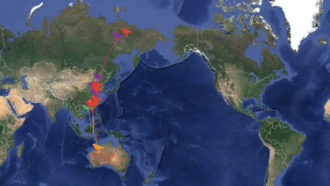
At Roebuck Bay, at Broome in northwest Australia, Grey Plovers which were given satellite transmitters starting in February 2016, and they have set off on northward migration, and arrived at the breeding grounds. These transmitter deployments were carried out by the Australasian Wader Studies Group (AWSG) Wader and Tern Expedition 2016.
For more information see:
https://birdlife.org.au/campaigns/the-marvel-of-migration
Posted by Yvonne Verkuil on 13 June 2016
At Roebuck Bay, at Broome in northwest Australia, Grey Plovers which were given satellite transmitters starting in February 2016, and they have set off on northward migration, and arrived at the breeding grounds. These transmitter deployments were carried out by the Australasian Wader Studies Group (AWSG) Wader and Tern Expedition 2016. For more information see: https://birdlife.org.au/campaigns/the-marvel-of-migration
Posted by Yvonne Verkuil on 13 June 2016
The newest blog of Graham Appleton: "If you’re thinking of using geolocators to study bird migration then here’s a paper that you should read." Devices attached to waders (shorebirds) are adding hugely to our understanding of their movements, and informing plans for the conservation of threatened species, but how safe are these devices for the individual birds that carry them? Emily Weiser and 49 coauthors have reviewed the available evidence in a recent paper Effects of geolocators on
WHSRN welcomes Delta del Estero Real as the 95th site in the Network, and 1st in Nicaragua! It was designated a Site of International Importance for supporting more than 10% of the biogeographic population of Wilson's Plover (
Charadrius wilsonia). Nicaragua is now the 15th country to join WHSRN.
read more
here.
Posted by Silke Nebel on 30 May 2016
WHSRN welcomes Delta del Estero Real as the 95th site in the Network, and 1st in Nicaragua! It was designated a Site of International Importance for supporting more than 10% of the biogeographic population of Wilson's Plover (Charadrius wilsonia). Nicaragua is now the 15th country to join WHSRN. read more here.
The Humedales de Maullín (Maullín Wetlands), in the Llanquihue Province, becomes the 5th WHSRN site in Chile and 94th site in the Network. It was designated a Site of Regional Importance for supporting more than 1% of the biogeographic population of Hudsonian Godwit (
Limosa haemastica).
read more
here.
Posted by Silke Nebel on 30 May 2016
The Humedales de Maullín (Maullín Wetlands), in the Llanquihue Province, becomes the 5th WHSRN site in Chile and 94th site in the Network. It was designated a Site of Regional Importance for supporting more than 1% of the biogeographic population of Hudsonian Godwit (Limosa haemastica). read more here.
Based on having met WHSRN’s biological and landowner commitment criteria, the
Bahía Blanca Estuary (
Estuario de la Bahía Blanca) in
Argentina was unanimously approved as a
WHSRN Site of Regional Importance recently by the WHSRN Hemispheric Council.
Located in the southwest portion of Buenos Aires Province, the new WHSRN site encompasses the entire ecosystem of the
Bahía Blanca Estuary. It includes national, provincial, and municipal jurisdictions as well as private properties.
The site, totaling
262,527 hectares, was proposed under the category of "regional importance" for supporting more than
20,000 shorebirds per year, including
more than 1% of the biogeographic population of
Red Knot (
Calidris canutus rufa),
White-rumped Sandpiper (
Calidris fuscicollis),
Hudsonian Godwit (
Limosa haemastica),
Two-banded Plover (
Charadrius falklandicus), and
American Oystercatcher (
Haematopus palliatus durnfordi).
Read more
here.

Bahía Blanca Estuary supports more than 20,000 shorebirds each year. / © Pablo Petracci
Posted by Silke Nebel on 21 April 2016
Based on having met WHSRN’s biological and landowner commitment criteria, the Bahía Blanca Estuary (Estuario de la Bahía Blanca) in Argentina was unanimously approved as a WHSRN Site of Regional Importance recently by the WHSRN Hemispheric Council.
Migratory shorebirds inhabit many countries on their annual journeys. These journeys are awe-inspiring, but the migratory lifestyle of shorebirds puts them into a legal predicament that has resulted a complex conservation challenge. In a way, they have multiple “citizenships”. As stated eloquently by Watts and Turrin in their
paper in
this issue of Wader Study1, “states have sovereign rights over all wild animals that fall within their jurisdictional boundaries but no jurisdiction over animals outside of these boundaries”. This means that migrating shorebirds are subject to the policies of all of the countries they visit, in succession. When these policies include hunting, it is easy to imagine how sustainable limits could be crossed.
Shorebird hunting is legal in many jurisdictions in the Western Hemisphere. Although each jurisdiction might set sustainable limits, there is not enough information on the cumulative number of individuals killed along an entire migratory route – the collective harvest – to assess whether per species limits are sustainable across a flyway. Estimates of sustainable mortality limits for 36 species using the Western Atlantic Flyway showed that hunting pressure might already be too high for several species
2. Too many birds are being taken – perhaps not in any one country, but across a flyway – to maintain population sizes necessary to meet biological and social needs.
To set sustainable limits across a flyway, we must first understand the policies that govern shorebird hunting for each jurisdiction within that flyway: whether or not shorebirds can be hunted, when during the year, by whom and in what numbers. Watts and Turrin present a benchmark assessment of shorebird hunting policies in the Western Hemisphere. Their study area including jurisdictions within the primary shorebird flyways of the Western Hemisphere: the Western Atlantic Flyway, the East Pacific Flyway, and the Mississippi or Interior American Flyway.
How does one go about finding out what shorebird hunting policies (both domestic policies and international conventions and treaties) are over such a large area? First the researchers focused on 45 migratory shorebird species, excluding sedentary species, short-distance migrants (species that exhibit only local movements) and vagrants. Then they decided to categorize three levels of protection: 1) not protected, 2) seasonally protected, and 3) fully protected. Finally, they narrowed their focus to policies on subsistence, commercial, and sport/recreational hunting, excluding the killing of shorebirds for nuisance/control or scientific collecting. With these limits in mind, the researchers systematically searched for legislation from each jurisdiction, using government databases, national official gazettes, national hunting calendars, peer-reviewed journal articles, government agency reports, websites of international conventions and treaties (CITES, CMS, SPAW), and reports by independent scientific or conservation organizations such as BirdLife International and the Caribbean Environment Programme. Finally, when they could not find information on details such as bag limits or seasons in the legislation, they consulted local contacts, provincial or state hunting calendars, and local online news sources.
The researchers identified a total of 57 jurisdictions in the Western Hemisphere, including 35 independent nations and 22 dependent territories or other entities. The dependencies included overseas departments and collectivities of France, constituent countries and special municipalities of the Netherlands, overseas territories of the United Kingdom, and unincorporated organized territories of the United States. Most of these diverse jurisdictions (96.5%) participate in at least one international treaty designed to protect migratory birds and of these jurisdictions, nearly 90% have established corresponding domestic laws.
The researchers found that most of the domestic wildlife policies (91.2%) fell into two categories: policies that protect all or nearly all (>90%) migratory shorebirds, or policies that protect very few (<10%). In many ways, the heterogeneity reflects the political histories of the jurisdictions, many of which are political units of European countries. For example, the majority of jurisdictions that are overseas territories of the United Kingdom have complete prohibitions on shorebird hunting, while the majority of overseas departments and collectivities of France have relatively liberal hunting policies.
Of the 27 jurisdictions that authorize some form of shorebird hunting, 22 (81.5%) require a hunting license, 14 (51.8%) specify a hunting season and 12 (44.4%) have bag limits for at least a portion of the hunted species. Commercial hunting is not acknowledged in the policies of most jurisdictions. It is explicitly authorized in Venezuela and prohibited in 23 jurisdictions. Recreational hunting of shorebirds is legal in 16 jurisdictions, but only occurs in practice in 11 of these, 10 of which are within the Western Atlantic Flyway. Finally, subsistence hunting has legal status in 16 jurisdictions, including 10 where all other forms of shorebird hunting are prohibited. Subsistence hunting is widespread throughout rural communities and is accepted in many cultures regardless of national policy. Therefore, it may have the largest collective impact on shorebird populations.
[caption id="attachment_7925" align="alignnone" width="631"]

Young boy with shorebirds hunted for subsistence in the Bay of Martaban, Myanmar, Jan 2010 (Photo provided by the Biodiversity and Nature Conservation Association of Myanmar).[/caption]
An example of how even moderate subsistence hunting can have a large impact on a vulnerable species is found in the story of the Spoon-billed Sandpiper in Myanmar. Bird hunting provides the poorest in Myanmar society with a reliable source of protein and sometimes a small livelihood. But it has a devastating effect on some shorebirds. Previous research by an international team of scientists from the United Kingdom, Myanmar, Russia and Thailand has shown that hunting in Myanmar is probably the main cause of the decline of the Spoon-billed Sandpiper
3. How to balance the needs of the birds with the needs of the poorest people in Myanmar? Interventions by the Biodiversity and Nature Conservation Association of Myanmar (BANCA) and the Spoon-billed Sandpiper Recovery Team may hint at an answer. BANCA carried out education and awareness raising activities in the villages concurrent with a socio-economic intervention that provided villagers with assets such as livestock, fishing boats and building materials so that they could begin replacement livelihoods. In exchange, the villagers vowed to stop bird hunting. Early reports indicate that the intervention may be having a positive effect for both the birds and the people
4.
The example of the Spoon-billed Sandpiper shows success by working from the bottom up. Success is also possible working from the top down and Watts and Turrin’s benchmark assessment of shorebird hunting policies brings us one step closer to such success. Now that we have a synthesis on hunting policies across the Western Atlantic Flyway, more information is needed on the collective, legal harvest of all shorebirds. Putting together information on current policies, collective harvests, and the mortality tolerances of different shorebird species will bring us closer to the conservation objective of hunting policies that ensure the future health of hunted populations by limiting take to, or below, the limits of what populations are capable of withstanding.
_________________________________________
Deborah M. Buehler
Outreach Editor, ‘Wader Study’
- Watts, B.D. & C. Turrin. 2016. Assessing Hunting Policies for Migratory Shorebirds throughout the Western Hemisphere. Wader Study 123(1): 6-15.
- Watts, B.D., E.T. Reed & C. Turrin. 2015. Estimating sustainable mortality limits for shorebirds using the Western Atlantic Flyway. Wader Study 122(1): 37–53.
- Zöckler, C., T. Htin Hla, N. Clark, E. Syroechkovskiy, N. Yakushev, S. Daengphayon & R. Robinson. 2010. Hunting in Myanmar is probably the main cause of the decline of the Spoon-billed Sandpiper Calidris pygmeus. Wader Study Group Bulletin 117(1): 1–8.
- https://www.birdlife.org/asia/news/targeting-hunters-save-spoon-billed-sandpiper
PDF version can be downloaded
here.
Posted by Deborah Buehler on 20 April 2016
Migratory shorebirds inhabit many countries on their annual journeys. These journeys are awe-inspiring, but the migratory lifestyle of shorebirds puts them into a legal predicament that has resulted a complex conservation challenge. In a way, they have multiple “citizenships”. As stated eloquently by Watts and Turrin in their paper in this issue of Wader Study1, “states have sovereign rights over all wild animals that fall within their jurisdictional boundaries but no jurisdiction over
With Disney-Pixar’s newest animated feature
Finding Dory right around the corner, fans have been wondering just what the new animated short will be before the main feature starts. The newest member of the Pixar family is an adorable, big-eyed beach bird named Piper.

According to Pixar, the inspiration for the six minutes short film (about a hungry baby Sandpiper overcoming it’s fear of the water) came from Emeryville, California where Alan Barillaro, a veteran Pixar animator and director of
Piper, would gleefully run alongside the shore and noticed thousands of birds fleeing from the water, but returning almost immediately between the waves to eat.
“Seeing the way these sandpipers react to waves and run, I always felt, ‘Gosh, that’s a film, that’s a character,” says Barillaro, who began toying with animation software as a personal challenge to design a non-speaking character who was afraid of the water yet had to venture into it to eat. “It’s always fun to show a world we’re familiar with but from a different perspective. We’ve all been to the beach, but have we ever viewed water from just an inch off the sand? That could be very fearful from a bird’s perspective.”
As the story took on a life of it’s own,
Piper became a story of a child learning the ways of the food chain through a parent, and then a child learning from another child, as Piper meets and befriends a tiny hermit crab who teaches her how to get the job done.
“It’s the kid at the playground feeling,” says Barillaro. “You fall down and you feel so small, but you look and see someone even smaller than you brush themselves off and tackle something, and learn from that in your own way. It was important to me to stay in the kid world and see the world from Piper’s eyes, and not be from the human perspective.”
as seen in
Inside the Magic.
Posted by Silke Nebel on 8 April 2016
With Disney-Pixar’s newest animated feature Finding Dory right around the corner, fans have been wondering just what the new animated short will be before the main feature starts. The newest member of the Pixar family is an adorable, big-eyed beach bird named Piper.
Tough waders those Turnstones. Or maybe not so much? Read on in Graham Appleton's WaderTales!
https://wadertales.wordpress.com/2016/02/17/why-do-turnstones-eat-chips/
Photo courtesy: Allison Kew
Posted by Yvonne Verkuil on 30 March 2016
Tough waders those Turnstones. Or maybe not so much? Read on in Graham Appleton's WaderTales! https://wadertales.wordpress.com/2016/02/17/why-do-turnstones-eat-chips/ Photo courtesy: Allison Kew