
News
Death of the first two captive-bred spoonbill chicks at Slimbridge
From elation to devastation. Over the last few days, the two viable eggs at Slimbridge successfully hatched producing two perfect looking Spoon-billed Sandpiper chicks. The chicks seemed to do well initially but their health deteriorated and within 60 hours of hatching both chicks died. Read the full story and other spoonbill news here.
Congratulations Brett Sandercock and Susan Skagen!
Brett Sandercock and Susan Skagen have been made honorary members of the Cooper Ornithological Society!
Congratulations Guy Morrison!
Guy Morrison has been honoured by being made a Member of the Order of Canada!
Black-bellied plovers complete annual cycle
Three black-bellied plovers have been tracked from their wintering grounds back to their breeding grounds, completing the annual cycle of this species. These birds were originally tagged on Bathurst Island during the breeding season of 2015 by The Center for Conservation Biology and Canadian Wildlife Service staff. These birds were tracked to a broad range of wintering locations, and recently migrated back to their breeding grounds. This annual migration cycle of black-bellies was
Assessment of shorebird hunting policies published
One of the greatest challenges in managing migratory birds is that they exist within a legal quandary. As a recognized principle of international law, states have sovereign rights over all wild animals that fall within their jurisdictional boundaries but no jurisdiction over animals outside of these boundaries. The practical result of this principle is that animals that migrate from one jurisdiction to another are subject, in succession, to the sovereign rights and policies of all states along
Conservation in conflict: peregrines and shorebirds in the mid-Atlantic
The outer coast of the mid-Atlantic region has become an important site for the conservation of both breeding peregrine falcons and migratory shorebirds. The region is a terminal, spring staging area where several shorebird species stop for an extended stay to build fat reserves for their final flight to arctic breeding grounds. The region has served this role for thousands of years and includes designated Western Hemisphere Shorebird Reserves with both “hemispheric” and “international”
Symposium: The Wadden Sea – Still a reliable hub for migratory birds?
On 25 August 2016 a symposium will be held in Wilhelmshaven, analysing the status of migratory birds on the East-Atlantic Flyway. Trends in migratory bird numbers are showing an alarming decline for many bird populations in the Wadden Sea. It is not clear whether the causes of the observed declines are to be found in the Wadden Sea, somewhere else along the East Atlantic Flyway, or both. Further information can be found on the webpage of the Common Wadden Sea Secretariat.
New ABC/BBC Migratory Shorebirds Series
A new ABC/BBC series explores in 4 parts the monumental journey millions of shorebirds make between their breeding grounds in arctic tundra and their wintering grounds in Australasia. Episode I https://www.abc.net.au/radionational/programs/offtrack/flying-for-your-life-1/7461802 Episode II https://www.abc.net.au/radionational/programs/offtrack/flying-for-your-life-2/7479994
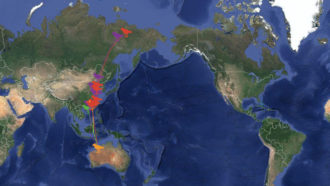
The Marvel of Migration – Grey Plover Tracking
At Roebuck Bay, at Broome in northwest Australia, Grey Plovers which were given satellite transmitters starting in February 2016, and they have set off on northward migration, and arrived at the breeding grounds. These transmitter deployments were carried out by the Australasian Wader Studies Group (AWSG) Wader and Tern Expedition 2016. For more information see: https://birdlife.org.au/campaigns/the-marvel-of-migration
WaderTales: Are there costs to wearing a geolocator?
The newest blog of Graham Appleton: "If you’re thinking of using geolocators to study bird migration then here’s a paper that you should read." Devices attached to waders (shorebirds) are adding hugely to our understanding of their movements, and informing plans for the conservation of threatened species, but how safe are these devices for the individual birds that carry them? Emily Weiser and 49 coauthors have reviewed the available evidence in a recent paper Effects of geolocators on