This is a call by John Goss-Custard & Richard Stillman to add your observation of feeding oystercatchers and your data about the site to their project.
Fig. 1 shows data for estuaries and coastal flats in Britain where most of the Eurasian Oystercatchers
Haematopus ostralegus during the non-breeding season obtain most of their food from the shellfish, common cockles
Cerastoderma edule and blue mussels
Mytilus edulis. It shows the proportion of oystercatchers foraging on mussel beds as a function of the proportion of the shellfish beds (
i.e. beds of cockles and mussels combined) that is comprised of mussels. If this function is widely applicable, we could estimate the numbers of oystercatchers in a site that forage on either cockles or mussels without actually having to count them. All that would be needed would be estimates of (i) the total number of oystercatchers; (ii) the total surface area of mussel beds, and (iii) the total surface area of the cockle beds. This could be useful for estimating, for example, the contribution made by each shellfish species to the total consumption of oystercatchers over the entire non-breeding season. It could also be used to demonstrate the special importance of mussel beds to oystercatchers when Environmental Impact Assessments are made.
 Fig. 1.
The proportion of oystercatchers foraging on mussel beds in relation to the proportion of the shellfish beds that consists of mussels. The large dots show the data for particular, named sites. The small dots show the expected hypothetical trend if the density of oystercatchers on the beds averages 30/ha.
Inevitably, the two points at the extremities – the Ythan and Dee estuaries – coincide with expectation as only one shellfish species is present! What matters is the region in between where there is a mixture of cockle and mussel beds and, at present, there are only three estimates. A larger sample size is required to test the expectation. Hence this request!
If you think you might be able to contribute a data point or two, please read on!!
Before describing how you might contribute, an explanation of how the expected curve in Fig. 1 was calculated. It was made for a series of hypothetical sites with approximately the same surface area and oystercatcher numbers as the Exe estuary but with the relative proportion of cockle:mussel bed areas varying from 0.9:0.1 to 0.1:0.9. The first assumption in calculating the expectation is that oystercatchers generally occupy mussel beds preferentially because of the large size and energy content of mussels compared with cockles. The second assumption is that, when the mussel beds are fully occupied, the remaining birds feed on cockle beds. The third assumption is that mussel beds are fully occupied when the average density of oystercatchers on them is 30/ha. This value is based on data from the three sites shown in Fig. 1: using densities of 20/ha or 40/ha to calculate the expected curve does not make much difference anyway.
Here is an example of the simple calculations involved. The mussel beds cover a combined area of 20ha out of the 100ha where shellfish of either or both species are present. The shellfish beds (cockles and mussels combined) support 1,500 oystercatchers. The proportion of oystercatchers on the mussel beds is therefore 0.4 ((30x20)/1,500) and the proportion of the site covered by mussels is 0.2 (20/100). So in this case, 0.4 of the shellfish-eating oystercatchers occur on the 0.2 of the combined shellfish beds that consists of mussels.
This is what is required for one site/occasion (year and season) for you to contribute a data point to the graph:
- Data from a site where, during part or the whole of a given non-breeding season, most of the oystercatchers over the low water period obtain most of their food from cockles and mussels. The site could be a whole estuary or coastal flat or a large enough part of a huge site to be considered a ‘unit’ within which most of the birds are likely to spend most of their time: g. the east side of the Wash or south side of the Solway Firth.
- Numbers of oystercatchers that typically forage on the mussel beds over the low water period. [If this is not available, it can be approximated by subtracting the number of oystercatchers on cockle beds (item 3) from the total numbers foraging on the mussel and cockle beds combined.]
- The numbers of oystercatchers that typically forage on the cockle beds over the low water period. [If this is not available, it can be approximated by subtracting the number of oystercatchers on mussel beds (item 2) from the total numbers foraging on the mussel and cockle beds combined.]
- The fully-exposed surface area of all the mussel beds combined.
- The fully-exposed surface area of all the cockle beds combined.
- The fully-exposed surface area of the entire intertidal area of mudflat and sand flat (excluding saltmarsh).
Item 6 is included because the area occupied by cockles (item 5) may not always be known. The current indications are that expressing the area of the mussel beds as a proportion of the entire intertidal area of mud and sand – including those parts without cockles – may still yield a usable function (Fig. 2).
 Fig. 2.
The proportion of oystercatchers foraging on mussel beds plotted against the proportion of the total surface area of intertidal mud-and sand-flats that are covered by mussels.
When we have acquired the data, we will prepare a manuscript and add your name and address to the list of authors, and circulate the manuscript for feed-back. If Figs. 1 and 2 are confirmed, they will prove to be very useful in a range of circumstances. So please do make the time to contribute if you have the data to do so!
John D. Goss-Custard* & Richard A. Stillman
Faculty of Science and Technology, University of Bournemouth, Poole, UK *Corresponding author: johngc66@gmail.com
Please address all correspondence to John Goss-Custard at:
johngc66@gmail.com.
Posted by Yvonne Verkuil on 28 March 2016
This is a call by John Goss-Custard & Richard Stillman to add your observation of feeding oystercatchers and your data about the site to their project. Fig. 1 shows data for estuaries and coastal flats in Britain where most of the Eurasian Oystercatchers Haematopus ostralegus during the non-breeding season obtain most of their food from the shellfish, common cockles Cerastoderma edule and blue mussels Mytilus edulis. It shows the proportion of oystercatchers foraging on mussel beds as a
This is the first time that Bar-tailed Godwits are being tracked within the West Asia-East African flyway.

The intertidal ecosystem of Barr Al Hikman in the Sultanate of Oman is one of the last large pristine wetlands in the Middle-East. Barr Al Hikman is of major importance as a nursery and feeding area for shrimps, fishes, crabs and green turtles and it is the most important wetland for shorebirds in the Middle-East. With our study we aim for an advanced understanding of the ecological processes that are shaping this unique system.
Click
here to learn more about the bar-tailed godwit project, and
here to learn about the crab plover project.
Posted by Silke Nebel on 11 March 2016
This is the first time that Bar-tailed Godwits are being tracked within the West Asia-East African flyway.
The large wader stopover in Khairusova-Belogolovaya estuary on the Western coast of Kamchatka peninsula is not very famous and scientists have started investigate this area only several years ago. The last expedition in 2015, the estuary was found to host 31 wader species. During the peak of migration, in the end of July, we counted about 26 000 waders.
Most numerous in this area are Great Knots (up to 23 000), Bar-tailed and Black-tailed Godwits, Red-necked Stints and Dunlins. Also we often recorded there rare species – Spoon-billed Sandpipers and Far-Eastern Curlews.
From middle of June till the middle of August 2016 we are planning to continue our field work in this area and looking for volunteers. We are planning the following activities:
- Wader counts
- Reading individual flag codes on Great Knots and Godwits
- Maybe ringing waders and taking benthos samples.
We are looking for people with experience with wader counts and reading leg flags. The volunteers, preferably bringing their own scopes, can participate the whole field period or for the part of it. Main activities – wader counts and reading leg flags. Large part of Great Knots and some Godwits have individual leg flags, mostly from Australia.
Logistics
Travelling via Petropavlovsk to Ust-Khairusovo by plane. In the study area we live in field tent camp. Camp is protected with electric fence from bears. Main vehicle is motor boat. It is necessary to have all field equipment – rubber boots, rain jackets and pants, warm clothes etc.
Unfortunately our expedition this year is not able to pay for expedition costs.
The deadline of the applications is 20 March 2016
Are you interested, or do you have questions, please contact Dmitry Dorofeev dmitrdorofeev@gmail.com
-------------------In 2013 we published an article about our study in English------------------------
Dorofeev, Dmitry S., and Fedor V. Kazansky. "Post-breeding stopover sites of waders in the estuaries of the Khairusovo, Belogolovaya and Moroshechnaya rivers, western Kamchatka Peninsula, Russia, 2010–2012."
Wader Study Group Bull 120.2 (2013): 119-123.
Click here for PDF
Posted by Yvonne Verkuil on 1 March 2016
The large wader stopover in Khairusova-Belogolovaya estuary on the Western coast of Kamchatka peninsula is not very famous and scientists have started investigate this area only several years ago. The last expedition in 2015, the estuary was found to host 31 wader species. During the peak of migration, in the end of July, we counted about 26 000 waders. Most numerous in this area are Great Knots (up to 23 000), Bar-tailed and Black-tailed Godwits, Red-necked Stints and Dunlins. Also we often
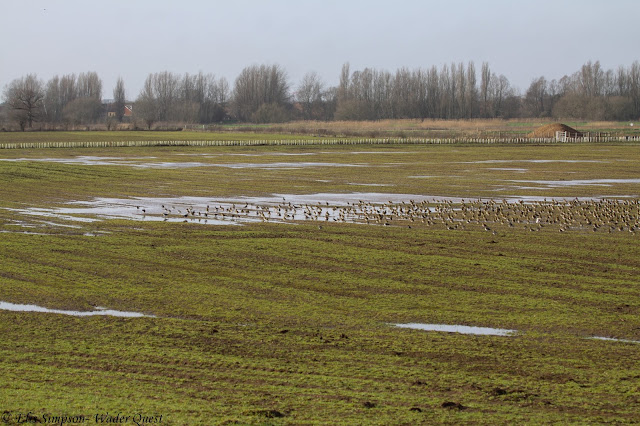
Read this nice report about one of the delights of NW Europe winters
at www.waderquest.org.
Wader Quest also published their January 2016 Newsletter, stock-full of global news on waders. It is available to Friends of Wader Quest, for details see
this page.
Posted by Yvonne Verkuil on 28 January 2016
Read this nice report about one of the delights of NW Europe winters at www.waderquest.org. Wader Quest also published their January 2016 Newsletter, stock-full of global news on waders. It is available to Friends of Wader Quest, for details see this page.

Graham Appleton reports that "predation by hedgehogs is having an ongoing impact on breeding success of wader nest on the Uist machair, at least some of which is additional to that of gulls, which take both eggs and chicks."
Read more on
the WaderTales blog
Posted by Yvonne Verkuil on 28 January 2016
Graham Appleton reports that "predation by hedgehogs is having an ongoing impact on breeding success of wader nest on the Uist machair, at least some of which is additional to that of gulls, which take both eggs and chicks." Read more on the WaderTales blog

The Center for Conservation Biology, in partnership with the Canadian Wildlife Service, has tracked black-bellied plovers from their Arctic breeding locations and fall stopover locations to their wintering grounds. The plovers were trapped on the breeding grounds
(...)
Photos by Fletcher Smith and Bart Paxton (Bay of Panama).
Posted by Silke Nebel on 15 January 2016
The Center for Conservation Biology, in partnership with the Canadian Wildlife Service, has tracked black-bellied plovers from their Arctic breeding locations and fall stopover locations to their wintering grounds. The plovers were trapped on the breeding grounds (...) Photos by Fletcher Smith and Bart Paxton (Bay of Panama).
The Black-tailed Godwit has expanded it range in Iceland (above) and in western Russia (Photo courtesy: Tómas Gunnarsson)
" At the same time as
limosa numbers in the west of the range have been dropping by an average of 5% per year, there has been colonisation of areas of Russia that are beyond what was thought to be the northern edge of the subspecies’ range. Over a similar time period there has also been a well-documented range expansion of the
islandica subspecies, about which more later."
Read more at:
the Wader Tales blog.
Posted by Yvonne Verkuil on 21 December 2015
The Black-tailed Godwit has expanded it range in Iceland (above) and in western Russia (Photo courtesy: Tómas Gunnarsson) " At the same time as limosa numbers in the west of the range have been dropping by an average of 5% per year, there has been colonisation of areas of Russia that are beyond what was thought to be the northern edge of the subspecies’ range. Over a similar time period there has also been a well-documented range expansion of the islandica subspecies, about which more
Here is a link to the blog of Graham Appleton called 'Wader Tales'. This issue discusses the assumption that managers of nature reserves know how to provide the right foraging conditions for Lapwing and Redshank chicks. Graham discussed the research publish in Wader Study that shows that they do.
How quickly will this Lapwing chick grow? Photo: Andy Hay/RSPB images
https://wadertales.wordpress.com/2015/11/30/how-well-do-lapwings-and-redshanks-grow/
Posted by Yvonne Verkuil on 17 December 2015
Here is a link to the blog of Graham Appleton called 'Wader Tales'. This issue discusses the assumption that managers of nature reserves know how to provide the right foraging conditions for Lapwing and Redshank chicks. Graham discussed the research publish in Wader Study that shows that they do. How quickly will this Lapwing chick grow? Photo: Andy Hay/RSPB images https://wadertales.wordpress.com/2015/11/30/how-well-do-lapwings-and-redshanks-grow/
With special attention to flyway populations making use of the Wadden Sea
Marc van Roomen, Szabolcs Nagy. Ruud Foppen, Tim Dodman, Geoffroy Citegetse & Abdoulaye Ndiaye put together a beautiful report with sobering news:
They document that adverse environmental changes in the Wadden Sea are stronger than elsewhere on the flyway, and that trends in the Wadden Sea are mainly caused by these local factors, especially since populations which also breed in the Wadden Sea seem to be particularly vulnerable. The patterns found are strong indications that many flyway populations studied are under pressure. Further research and monitoring, especially also on threats along the flyway, are needed to pinpoint causes and to help identify priority conservation measures.
The full report can be downloaded
here.
Posted by Silke Nebel on 11 December 2015
With special attention to flyway populations making use of the Wadden Sea Marc van Roomen, Szabolcs Nagy. Ruud Foppen, Tim Dodman, Geoffroy Citegetse & Abdoulaye Ndiaye put together a beautiful report with sobering news:
In November, the black-tailed godwit (grutto) was voted the Netherlands' national bird. The Dutch-Frisian artist Syb van der Ploeg wrote a song for the king of the Dutch meadows. Also the accompanying video is very nice. Enjoy watching and listening.
Photo courtesy: Peter van de Beek.
https://www.youtube.com/watch?v=eiuv9HdYLQ4&feature=share
Posted by Yvonne Verkuil on 9 December 2015
In November, the black-tailed godwit (grutto) was voted the Netherlands' national bird. The Dutch-Frisian artist Syb van der Ploeg wrote a song for the king of the Dutch meadows. Also the accompanying video is very nice. Enjoy watching and listening. Photo courtesy: Peter van de Beek. https://www.youtube.com/watch?v=eiuv9HdYLQ4&feature=share
