
The minutes of the December 2016 annual
Alaska Shorebird Group (ASG) meeting are now available!
Read the minutes
The ASG held its annual meeting on 6 December 2016 in Cordova, Alaska during the Alaska Bird Conference. Papers and posters on shorebird studies and conservation were given over the following few days at the 2016 Alaska Bird Conference A whole session of the meeting was devoted to studies and conservation of shorebirds.
Read talk abstracts
Other ASG resources include:
[caption id="attachment_9099" align="aligncenter" width="330"]

Black oystercatchers
Haematopus bachmani observed during 2016 surreys in Prince William Sound. Photo ©Matthew Prinzing, SCA Intern, USFS. Retrieved from the 2016 annual summary of new or ongoing studies of Alaska shorebirds.[/caption]
Featured image: Western sandpipers
Calidris mauri at Cordova, Alaska. ©2005 Arthur Morris/Birds as art.
Posted by Gwenaël Quaintenne on 23 March 2017
The minutes of the December 2016 annual Alaska Shorebird Group (ASG) meeting are now available! Read the minutes The ASG held its annual meeting on 6 December 2016 in Cordova, Alaska during the Alaska Bird Conference. Papers and posters on shorebird studies and conservation were given over the following few days at the 2016 Alaska Bird Conference A whole session of the meeting was devoted to studies and conservation of shorebirds. Read talk abstracts Other ASG resources include: List of newly
A model for collaborative conservation research
Identifying the causes of the problems of the Numeniini is not easy. Species such as the Little Curlew breed in some of the most remote areas of the world, whilst the wintering areas of Bristle-thighed Curlews are spread across the Pacific islands. Understanding the full annual cycle requires international cooperation, willingly provided by scientists and volunteer ornithologists who share a common concern about these species.
One of the key elements of the paper-production process was a workshop at the 2013
International Wader Study Group conference in Wilhelmshaven, Germany. This was led by Nicola Crockford, Principal Policy Officer at RSPB
, James Pearce-Higgins (BTO), Daniel Brown (RSPB), David Douglas (RSPB) and Jennifer Gill (University of East Anglia). It was preceded by a questionnaire survey of experts throughout the world, conducted by Daniel Brown and funded by RSPB. This two-stage process brought together information relating to population trends, demographic parameters (e.g. nesting success and survival rates) and actual/potential conservation threats.
Continue reading
Graham Appleton original post here on wadertales:
https://wadertales.wordpress.com/author/grahamfappleton/
Free full text original article published in Bid Conservation International:
Pearce-Higgins, J.W., Brown, D.J., Douglas, D.J.T., A., J.A., B., M., B., P., Buchanan, G.M., Clay, R.P., Conklin, J., Crockford, N., Dann, P., Elts, J., Friis, C., Fuller, R.A., Gill, J.A., Gosbell, K., Johson, J.A., Marquez-Ferrando, R., Masero, J.A., Melville, D.S., Millington, S., Minton, C., Mundkur, T., Nol, E., Pehlak, H., Piersma, T., Robin, F., Rogers, D.I., Ruthrauff, D.R., Senner, N.R., Shah, J.N., Sheldon, R.D., Soloviev, S.A., Tomkovich, P.S. & Verkuil, Y.I. (2017) A global threats overview for Numeniini populations: Synthesising expert knowledge for a group of declining migratory birds. Bird Conservation International 27(1): 6-34.
Featured image: ©Axelkr, Iceland 2009.
Posted by Gwenaël Quaintenne on 9 March 2017
A model for collaborative conservation research Identifying the causes of the problems of the Numeniini is not easy. Species such as the Little Curlew breed in some of the most remote areas of the world, whilst the wintering areas of Bristle-thighed Curlews are spread across the Pacific islands. Understanding the full annual cycle requires international cooperation, willingly provided by scientists and volunteer ornithologists who share a common concern about these species. One of the key
Dear Members of the Wader Study Group,
Dear Wader Biologists,
After our finding that male pectoral sandpipers fly thousands of kilometers through the arctic breeding range (
https://go.nature.com/2j0ctW0), we want to understand how this behavior influences the population genetic structure of this species. Based on microsatellite markers, we genotyped a large sample of males caught in Barrow including those that went W to the Russian Arctic and E to the Canadian Arctic. Jakob Mueller analyzed the data and found no evidence for any structure, which is what we expected if males can move and reproduce across such a large geographical scale.
However, we can also test for a population structure using mitochondrial DNA, which is exclusively maternally inherited. This is interesting, because we do not know much about how female pectoral sandpipers sample breeding areas. The only information we have is that between-year site-fidelity is very low, but females could still return to the general area where they were born year after year. In this way, there could still be differences in mtDNA between e.g. Russian and Canadian breeding birds. Pavel Tomkovich already kindly provided 17 samples from females from Taimyr. An initial analysis of those samples, combined with samples from Barrow shows that there are a large number of haplotypes, but only limited evidence for a population structure.
We would now like to ask for your help to find out whether a population structure in females exists or whether the pectoral sandpiper is truly panmictic! To answer this, we want to extend the range of sampling as well as the sample size.
So,
- Do you have blood/feather/DNA samples from adult female pectoral sandpipers?
- Do you work in an area outside Barrow where pectoral sandpipers nest and samples from females can be obtained?
If so, we would be grateful if you can contact us at
b.kempenaers@orn.mpg.de
Thanks & best wishes,
Jakob Mueller, Wolfgang Forstmeier, Mihai Valcu & Bart Kempenaers
Prof. Dr. Bart Kempenaers
Director Dept Behavioural Ecology & Evolutionary Genetics
Max Planck Institute for Ornithology
E Gwinnerstr
82319 Seewiesen
Germany
Tel +49 8157 932334
Mobile +49 172 8351578
Featured photo: Pectoral sandpiper - ©Max Planck Institute for Ornithology, Wolfgang Forstmeier
Posted by Gwenaël Quaintenne on 13 February 2017
Dear Members of the Wader Study Group, Dear Wader Biologists, After our finding that male pectoral sandpipers fly thousands of kilometers through the arctic breeding range (https://go.nature.com/2j0ctW0), we want to understand how this behavior influences the population genetic structure of this species. Based on microsatellite markers, we genotyped a large sample of males caught in Barrow including those that went W to the Russian Arctic and E to the Canadian Arctic. Jakob Mueller
The 2017 edition, the
8th Woodcock and Snipe Workshop, will be held in the village of Madalena, Pico island (Azores, Portugal) from 9 to 11 May (organized by CIBIO-InBIO, Centro de Investigação em Biodiversidade e Recursos Genéticos, and ONCFS, Office national de la chasse et de la faune sauvage).
The Woodcock and Snipe Workshop aims to share knowledge on all aspects of every woodcock and snipe species: biology, habitats, population dynamics, census techniques, monitoring, hunting statistics, management & conservation, capture techniques.
To know more about this event, please visit the official website:
https://sites.google.com/view/wssg-workshop-2017

Registration deadline: 31 March 2017
Posted by Gwenaël Quaintenne on 13 February 2017
The 2017 edition, the 8th Woodcock and Snipe Workshop, will be held in the village of Madalena, Pico island (Azores, Portugal) from 9 to 11 May (organized by CIBIO-InBIO, Centro de Investigação em Biodiversidade e Recursos Genéticos, and ONCFS, Office national de la chasse et de la faune sauvage). The Woodcock and Snipe Workshop aims to share knowledge on all aspects of every woodcock and snipe species: biology, habitats, population dynamics, census techniques, monitoring, hunting statistics,
Following in the footsteps of Chamberlain's LBJs, the book written and illustrated by
Faansie Peacock includes more than 600 new paintings, covers the ID and biology of 80 species (+ 21 potential vagrant species) of waders found in Southern Africa including sheathbills, pratincoles, coursers & buttonquails! Based on the most up to date and accurate scientific knowledge, the book is also packed with extra info about wader biology & ecology that make this regional guide unique.
For previews, visit the homepage of the book on the author's website:
https://faansiepeacock.com/waders-book/
The book is available for pre-order in Europe at NHBS -
https://www.nhbs.com/browse/search?q=chamberlain%27s+waders
Posted by Gwenaël Quaintenne on 18 January 2017
Following in the footsteps of Chamberlain's LBJs, the book written and illustrated by Faansie Peacock includes more than 600 new paintings, covers the ID and biology of 80 species (+ 21 potential vagrant species) of waders found in Southern Africa including sheathbills, pratincoles, coursers & buttonquails! Based on the most up to date and accurate scientific knowledge, the book is also packed with extra info about wader biology & ecology that make this regional guide unique. For
After having journeyed half way across the globe, male
Pectoral sandpipers Calidris melanotos visit up to 24 potential breeding sites and flying thousands of kilometers within their breeding range in the Arctic to increase their reproductive success, shows a new study in Nature by
Mihai Valcu and
Bart Kempenaers from the Max Planck Institute for Ornithology:
Kempenaers, B. & Valcu, M. (2017) Breeding site sampling across the Arctic by individual males of a polygynous shorebird. Nature, advance online publication, 1-4. doi:10.1038/nature20813.
Learn more there about how Bart Kempenaers and his colleagues have conducted this study in arctic:
[caption id="attachment_9010" align="aligncenter" width="330"]

In this richly illustrated blog, Bart Kempenaers from the Max Planck Institute for Ornithology describes the details of the study.- "Behing the paper" from Nature Ecology and Evolution.[/caption]
Featured photo: Pectoral sandpiper - ©Max Planck Institute for Ornithology, Bart Kempenaers
Posted by Gwenaël Quaintenne on 16 January 2017
After having journeyed half way across the globe, male Pectoral sandpipers Calidris melanotos visit up to 24 potential breeding sites and flying thousands of kilometers within their breeding range in the Arctic to increase their reproductive success, shows a new study in Nature by Mihai Valcu and Bart Kempenaers from the Max Planck Institute for Ornithology: Kempenaers, B. & Valcu, M. (2017) Breeding site sampling across the Arctic by individual males of a polygynous shorebird. Nature,
Given his towering contributions to individual-based models of shorebird populations looking for impact of human activities on survival and body condition, John Goss-Custard does not need to be introduced anymore to shorebird community.
Last month, he has launched his blog entitled “Birds and Estuaries” with the aim of sharing his research works run over the past 30 years on the disturbance and harvesting of mussels of shorebirds on the Exe estuary. You will find on it some of his results that are not yet published!
Please check out and follow his blog here:
www.birdsandestuaries.blogspot.co.uk!
[caption id="attachment_8997" align="aligncenter" width="330"]
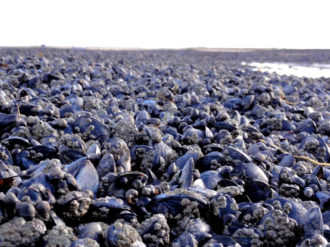
On the Exe, J.D. Goss-Custard and and his colleagues have mainly investigated whether disturbance and/or the harvesting of mussels had a significant effect on oystercatchers. Photo: dense mussel beds on the Exe estuary. © J. D. Goss-Custard[/caption]
Posted by Gwenaël Quaintenne on 12 January 2017
Given his towering contributions to individual-based models of shorebird populations looking for impact of human activities on survival and body condition, John Goss-Custard does not need to be introduced anymore to shorebird community. Last month, he has launched his blog entitled “Birds and Estuaries” with the aim of sharing his research works run over the past 30 years on the disturbance and harvesting of mussels of shorebirds on the Exe estuary. You will find on it some of his results
According to the
The State of North America’s Birds 2016 report “Shorebird populations have shrunk by 70% across North America since 1973, and the species that breed in the Arctic are among the hardest hit”. Drawing on this, Margaret Munro explores in a
Nature News Feature the diverse and widespread threats that shorebirds encounter along their path,
with a particular focus, among other things, to the recent research works conducted on Red knot and how conditions in the Arctic are altering breeding and survival of shorebirds:
News Feature "What’s killing the world’s shorebirds?" published in Nature:
Nature 541,16–20 (05 January 2017) doi:10.1038/541016a
Photo: Waders in flight, Delaware Bay ©
Simon Gillings
[caption id="" align="aligncenter" width="630"]
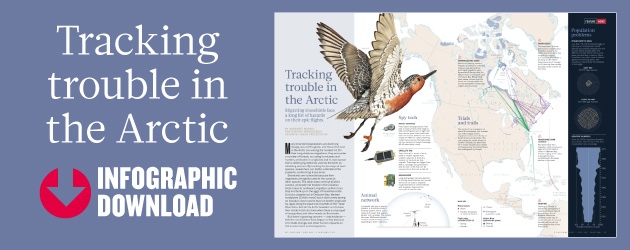
"Tracking trouble in the Arctic" Nature infographic pages. ©nature[/caption]
Posted by Gwenaël Quaintenne on 9 January 2017
According to the The State of North America’s Birds 2016 report “Shorebird populations have shrunk by 70% across North America since 1973, and the species that breed in the Arctic are among the hardest hit”. Drawing on this, Margaret Munro explores in a Nature News Feature the diverse and widespread threats that shorebirds encounter along their path, with a particular focus, among other things, to the recent research works conducted on Red knot and how conditions in the Arctic are altering
My school-aged kids and their friends are obsessed with poo. They talk about it, point it out on hikes, and try to decipher what the animal that made the deposit had eaten. They are little scatologists. Turning our attention to poo can tell us a lot about an animal, especially when one applies modern technology to the science of scatology.
The fusion of animal droppings with molecular lab techniques is called molecular scatology, or
polymerase chain reaction (PCR) on poo. In
this issue of Wader Study, Novic, Veit, Mizrahi and Symondson apply molecular scatology to shorebirds on stopover during spring migration in Delaware Bay. In their
article1, they describe how they collected fecal samples from shorebirds and performed amphipod specific PCR on these samples to figure out whether amphipods form part of the shorebird diet in Delaware Bay.
Delaware Bay is known as a critical stopover site for shorebirds on spring migration and it is well known that the eggs of spawning Horseshoe Crabs
Limulus polyphemus provide an essential food source. An earlier
study2, conducted by the same researchers, focused on detecting Horseshoe Crab DNA in bird feces and confirmed the importance of Horseshoe Crab eggs for migrating shorebirds. But the eggs seemed more important for some species than others, making the researchers wonder about other invertebrate food sources for shorebirds in Delaware Bay. The amphipod
Corophium volutator is a valuable prey item for shorebirds in the Bay of Fundy during fall stopover. Over 40 species of amphipod crustaceans have been reported in Delaware Bay, and the researchers wondered whether shorebirds were eating amphipods in the Bay.
Understanding how shorebirds use
all food resources at this critical stopover site will support more effective conservation and management.
But why the fancy techniques, why not just look at the poo? Often shorebird biologists
can figure out what the birds have been eating by looking closely at fecal samples. This is because some shorebirds, in some parts of the world, eat hard-shelled prey (like clams and mussels) whose shell fragments can still be identified in the feces. But in Delaware Bay, shorebirds are eating softer prey. Neither digested Horseshoe Crab eggs nor invertebrates like amphipods are easy to see in feces. Other methods, like flushing the stomach contents, are much more invasive, and small and soft prey is hard to see even then because shorebirds rapidly digest food. This is why molecular scatology is so useful.
To perform molecular scatology, the researchers first needed to ensure that the PCR primers reliably detected the amphipods they were targeting. To do this – and also to examine seasonal change in abundance of invertebrates throughout the stopover season – they took benthic core samples within foraging areas on the New Jersey side of Delaware Bay. They found that their primers did indeed detect amphipod species. They also found that densities of amphipods in Delaware Bay were considerably lower than those of
C. volutator in the Bay of Fundy, and that the maximum densities of amphipods in the study sites were substantially lower than the densities of
Limulus eggs. But were the birds eating the amphipods (even though the eggs were more abundant)? And were the amphipods a more important food source for some species but not others?
To find out, they needed to try their amphipod primers on poo. They caught shorebirds by mist-netting throughout May in both 2011 and 2012 and obtained fecal samples from individual birds by placing the birds in foil-lined boxes and collecting their droppings once they were deposited. As was the case with the benthic core samples, the primers successfully amplified amphipod DNA from the fecal samples. Amphipod DNA was present in samples from all four species tested: Dunlins, Least Sandpipers, Semipalmated Sandpipers and Short-billed Dowitchers. These species are eating amphipods, in addition to Horseshoe Crab eggs, during spring stopover in Delaware Bay.
[caption id="attachment_8975" align="alignnone" width="670"]

Dunlin (left) and Short-billed Dowitcher (right) are two of the species found to be eating amphipods as an alternative prey in Delaware Bay. Photos: D. Buehler.[/caption]
In the 2012 data, they also found significant differences in occurrence of amphipods in feces of different species, with Least Sandpipers using this food sources more than Dunlins, Semipalmated Sandpipers and Short-billed Dowitchers. This is consistent with the Least Sandpiper tendency to forage in vegetated areas of tidal marshes where spawning crabs are uncommon. It is also consistent with the earlier finding that Limulus eggs were found in a smaller percentage of Least Sandpiper samples compared with other shorebird species
2. It seems that Least Sandpipers rely on amphipods, and probably other benthic invertebrates, rather than Horseshoe Crab eggs during spring stopover in Delaware Bay. The researchers also note that amphipods may also be an important food source for other shorebird species before crab eggs become available in early spring.
By blending old and new methods, the researchers gained a better understanding of how shorebirds use available resources at this critical stopover area. Such information is necessary for the effective conservation and management of both shorebirds and their foraging habitats. In Delaware Bay, we are learning that that tidal mudflats and marshes, where birds feed on various benthic invertebrates, are also important foraging habitats for shorebirds. Hence, new conservation strategies regarding these habitats should be considered in the future.
This study is one of many in which researchers have incorporated new technologies into the study of birds. Other innovations include the use geolocators for everything from discovering the flight paths of long distance migrants to studying their breeding biology in remote areas (as highlighted by a [paper] by Lisovski and colleagues, also in this issue of Wader Study
3. It is truly and exciting time for technology in the study of waders and other birds
4.
- Novcic, I., R.R. Veit, D.S. Mizrahi & W.O.C. Symondson. 2016. Molecular analysis of amphipods in the diets of migrating shorebirds. Wader Study 123(3): 195-201.
- Novcic, I., D.S Mizrahi, R.R. Veit & W.O.C. Symondson. 2015. Molecular analysis of the value of Horseshoe Crab eggs to migrating shorebirds. Avian Biology Research 8: 210–220.
- Lisovski, S., K. Gosbell, C. Hassell & C. Minton. 2016. Tracking the full annual-cycle of Great Knot, Calidris tenuirostris, a long distance migratory shorebird of the East-Asian Australasian Flyway. Wader Study 123(3): 177-189.
- Altshuler, D.L., K. L. Cockle, & W. A. Boyle. 2013 North American ornithology in transition. Biol Lett 9: 20120876. https://rsbl.royalsocietypublishing.org/content/9/1/20120876
PDF version can be downloaded
here.
Posted by Deborah Buehler on 7 January 2017
My school-aged kids and their friends are obsessed with poo. They talk about it, point it out on hikes, and try to decipher what the animal that made the deposit had eaten. They are little scatologists. Turning our attention to poo can tell us a lot about an animal, especially when one applies modern technology to the science of scatology. The fusion of animal droppings with molecular lab techniques is called molecular scatology, or polymerase chain reaction (PCR) on poo. In this issue of Wader
We received a number of strong applications for the 2016 IWSG Small Projects Grants, and after a careful consideration we are very pleased to inform you that, for its first year, the grant will support the project proposal of
Glenda D. Hevia &
Verónica L. D’Amico on
the impact of human activities on Two-Banded Plovers (Charadrius falklandicus) breeding at beaches in Northern Patagonia, Argentina.
Glenda Hevia is conducting PhD research on the impact of human disturbance on reproductive success, blood parameters and physical condition of the Two-Banded Plover (
Charadrius falklandicus) during their breeding season in northern Patagonia. She is supervised by
Verónica L. D’Amico at the Centro para el Estudio de Sistemas Marinos, Centro Nacional Patagónico (CESIMAR – CCT CONICET – CENPAT).
More details can be found on the IWSG Small Projects Grants page:
https://www.waderstudygroup.org/projects/iwsg-small-projects-grants-apply-now/
You can follow the study at this ResearchGate Project page!:
https://www.researchgate.net/project/Effects-of-human-activities-on-the-Two-banded-Plover-Charadrius-falklandicus-breeding-population-in-northern-Chubut-Patagonia-Argentina
And on facebook:
https://www.facebook.com/ChorloDobleCollar/
[caption id="attachment_8912" align="aligncenter" width="330"]
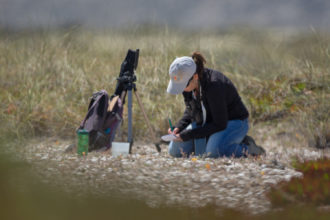
©Darío Podestá. Glenda D. Hevia collecting data from Two-Banded Plover nests during fieldwork at Península Valdés, Patagonia Argentina.[/caption]
We wish Glenda and Verónica every success with their fieldwork and research! The call for the 2017 grants will open in the Spring.
Photo: ©Darío Podestá. Two-Banded Plover adult breeder incubating a nest in Cerro Avanzado beach near Puerto Madryn city, Chubut, Patagonia Argentina.
Posted by Gwenaël Quaintenne on 19 December 2016
We received a number of strong applications for the 2016 IWSG Small Projects Grants, and after a careful consideration we are very pleased to inform you that, for its first year, the grant will support the project proposal of Glenda D. Hevia & Verónica L. D’Amico on the impact of human activities on Two-Banded Plovers (Charadrius falklandicus) breeding at beaches in Northern Patagonia, Argentina. Glenda Hevia is conducting PhD research on the impact of human disturbance on reproductive

