by Deborah Buehler originally published in Wader Study 132(2)
Do you know where your teens are? Back in the day, there were curfews for minors and Public Service Announcements (PSAs) inquiring, “It's 11 o'clock. Do you know where your children are?" Human teens aren’t the only juveniles that are hard to keep track of. In many wader species, the period between hatchling and adult is under studied and a clear understanding of where juvenile waders go when they leave for migration remains elusive. Nowadays, parents can use apps to keep track of their kids, day and night, and human teens aren’t the only ones who can be tracked.
In this issue of Wader Study, Alan H. Kneidel and colleagues used satellite and GPS transmitters to track juvenile Hudsonian Whimbrel
Numenius hudsonicus (hereafter Whimbrel) and documented movement patterns during migration and on the non-breeding grounds
1.
Whimbrel using the West Atlantic Flyway are in decline, and the population has been listed as a Bird of Conservation Concern by the United States Fish and Wildlife Service. A key information gap in identifying the cause of this decline is juvenile migration ecology and survival. Where do the juveniles go, what drives their behavior, and how do you monitor their health and safety? To answer these questions, Kneidel and colleagues deployed transmitters on juvenile Whimbrel in Cape Cod, Massachusetts, USA and then tracked the birds with the goals of: (1) establishing how Cape Cod is connected to other sites along Whimbrel migration routes; (2) filling information gaps on juvenile migration ecology and (3) establishing a long-term monitoring protocol for juvenile Whimbrel
Cape Cod, Massachusetts, USA, is a staging area where both juvenile and adult Whimbrel stop to refuel and rest on southbound migration. To determine the best sites within the staging area for capturing the birds, the researchers reviewed historical sites, anecdotal records, and eBird to find locations with the highest numbers of Whimbrel during southbound migration. Then they captured the birds using noose lines, which are an adaptation of noose carpets
2. In both, small monofilament nooses are attached to a surface (line or carpet) and are placed in areas where the birds feed. Noose lines are harder for the birds to see and better suited to peat banks in salt marshes. When a bird walks over the line, its foot can get caught in a noose that tightens. The researchers monitored the lines continuously and removed birds from the nooses immediately.
Once captured, Kneidel and colleagues determined which birds were juveniles by the presence of retained juvenile feathers. Then these juveniles were fitted with tiny ‘backpacks’ with leg-loop harnesses to hold a satellite or GPS transmitter. In all cases, the entire transmitter package was below 3% of the bird’s body mass. The transmitters were programmed to cycle between five hours on and 24 hours off.
[caption id="attachment_20053" align="aligncenter" width="673"]
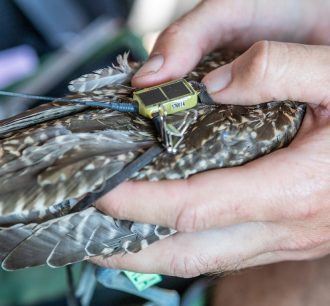
Attaching a “backpack” transmitter to a juvenile Whimbrel. (photo: Alan Kneidel)[/caption]
Kneidel and colleagues used transmitter data from eight juveniles captured between 2015 and 2022 to track migratory movements and to investigate local movements on Cape Cod and on the non-breeding grounds. They identified stopovers, staging areas, and non-breeding grounds for each bird. Stopovers were defined as rest sites used during migration for periods of time less than one week. Staging areas were defined as rest sites used during migration for one to six weeks. Finally, non-breeding grounds were defined as southern destinations used for extended periods (months to years).
Of the eight tagged juveniles, three stopped transmitting after 2–16 days giving no information about migration but yielding information about local movements in Cape Cod. The other five departed Cape Cod and flew nonstop across the Atlantic Ocean. This means that all southbound birds used Cape Cod as a terminal staging area before flying across the Atlantic to their non-breeding grounds. Two birds stayed at their landfall site throughout the non-breeding season, while another continued to a non-breeding site in Guyana. The final two birds staged in the same place, at Laguna Junca near a Petrochemical Complex in Anzoátegui, Venezuela, after their transatlantic flights. They then continued east along the northern coast of South America where one staged again in Guyana for 15 days before flying about 525 km to its non-breeding grounds in Suriname. The last bird stopped transmitting less than one day after leaving Laguna Juncal and flying 438 km east towards Tobago. One bird was still transmitting as it headed north towards the Flyway of the Americas, a pattern similar to that seen for adult Whimbrel.
Thus, the researchers met their goal of figuring out where the juveniles had gone, or in more scientific terms, they established migratory connectivity between Cape Cod and other sites along the flyway.
The researchers also strove to fill in information gaps about juvenile migration ecology. This sounds simple, but limitations in technology, difficulty of capture, and high juvenile mortality rates have made it challenging. Even though the sample size in this study was small, it gathered a wealth of information, including the first use of tracking data to document a delayed maturation period in a wader. One juvenile Whimbrel spent a year and a half in the British Virgin Islands and another spent two and a half years in Venezuela. This ‘over summering’ has been seen in other species such as Semipalmated Sandpipers
Calidris pusilla, where it increased survival enough to compensate for the lost breeding opportunities
3. Mounting evidence for extended stays at non-breeding sites emphasizes the importance of this period for the population's overall health and may impact conservation plans for shorebirds in the southern hemisphere.
Speaking of conservation plans, the researchers had a final goal of establishing a long-term monitoring protocol for juvenile Whimbrel. This study established Cape Cod as a study site in the Western Atlantic Flyway. The tracking data helped the researchers to identify nocturnal roost sites, including Jeremy Point and North Monomoy, used by juveniles and adults. These roosts can now be monitored regularly, and the site is already being used to deploy more tags as the researchers scale up their work tracking juveniles. This will allow them to leverage the opportunity to study adult and juvenile Whimbrel concurrently, as has begun for Eurasian Whimbrel from the population breeding in Iceland
N. phaeopus islandicus where researchers have found that juveniles fly non-stop to West Africa like adults, but depart later, travel more slowly, and take less direct routes
4.
[caption id="attachment_20054" align="aligncenter" width="673"]
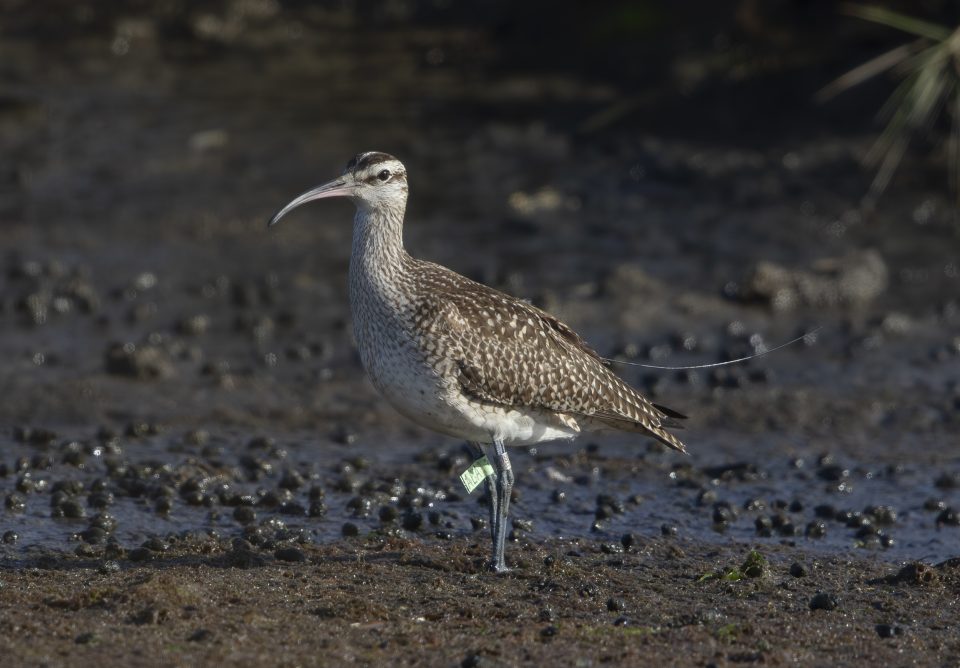
Juvenile Whimbrel wearing a transmitter. Note the antenna. (photo: Brad Winn)[/caption]
Like most wader species, Hudsonian Whimbrels are in decline
5. Their juveniles are facing an increasingly hostile world, destabilised by human-caused climate change, in which is it harder to survive and reproduce. Our teens too are facing instability and a world in which it is increasingly difficult to make a living. It’s no wonder that at recent graduations many teens were opting for a gap year (maybe akin to over-summering). Perhaps this is wise given uncertainly in job prospects (generative AI and economic instability), climate change (floods, fires and melting ice), and political instability. Now, more than ever, it’s important to know where our teens are— both juvenile waders and teenage humans—and to provide them with whatever support we can.
Author’s note: When I first started writing this column, just over ten years ago, I spotlighted a paper about Crab Plover parents. Back then I was searching for affordable and available childcare and was taken by the Crab Plovers innovative approach. Now I am parenting teens and worrying about where they are, and where they’ll go when they fledge. A lot has happened over the past decade, and this column has been a much-needed constant. I hope you have enjoyed reading it as much as I’ve enjoyed writing it.
Deborah M. Buehler
Outreach Editor, Wader Study
1 Kneidel, A.H., L. DiNunzio, S.A. Schulte & B. Winn. 2025.
The first tracking data for juvenile Hudsonian Whimbrel. Wader Study 132(2): 110–119.
2 Mehl, K.R., K.L. Drake, G.W. Page, P.M. Sanzenbacher, S.M. Haig & J.E. Thompson. 2003.
Capture of breeding and wintering shorebirds with leg-hold noose-mats.
Journal of Field Ornithology 74: 401–405.
3 Tavera, E.A., G.E. Stauffer, D.B. Lank & R.C. Ydenberg. 2020.
Oversummering juvenile and adult Semipalmated sandpipers in Perú gain enough survival to compensate for foregone breeding opportunity. Movement Ecology 8: 42.
4 Carneiro, C., T.G. Gunnarsson, T. Kaasiku, T. Piersma & J.A. Alves. 2024.
Icelandic Whimbrel first migration: Non-stop until West Africa, yet later departure and slower travel than adults. Ibis 166: 715–722.
5 Smith, P.A., A.C. Smith, B. Andres, C.M. Francis, B. Harrington, C. Friis, R.I.G. Morrison, J. Paquet, B. Winn & S. Brown. 2023.
Accelerating declines of North America’s shorebirds signal the need for urgent conservation action.
Ornithological Applications 125: 1–14.
PDF of this
article
Featured image: Juvenile Whimbrel in Cape Cod, Massachusetts, USA. (photo: Alan Kneidel).
Posted by Gwenaël Quaintenne on 20 February 2026
by Deborah Buehler originally published in Wader Study 132(2) Do you know where your teens are? Back in the day, there were curfews for minors and Public Service Announcements (PSAs) inquiring, “It's 11 o'clock. Do you know where your children are?" Human teens aren’t the only juveniles that are hard to keep track of. In many wader species, the period between hatchling and adult is under studied and a clear understanding of where juvenile waders go when they leave for migration remains
The American Birding Association has officially adopted a major taxonomic update: the ABA Checklist now recognizes two distinct Whimbrel species in North America — the Hudsonian Whimbrel (
Numenius hudsonicus) and the Eurasian Whimbrel (
Numenius phaeopus) (ABA Checklist Committee Update, January 2026).
[caption id="attachment_20004" align="aligncenter" width="645"]
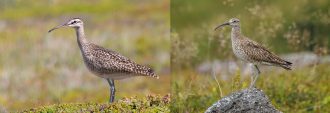
Hudsonian Whimbrels (
Numenius hudsonicus) — © Silver Leapers | Eurasian Whimbrels (
Numenius phaeopus) — © Charles J. Sharp[/caption]
This decision follows recent genomic research demonstrating long-term divergence and limited gene flow between trans-Beringian populations, notably:
McLaughlin, J. F., Faircloth, B. C., Glenn, T. C. & Winker, K. (2020). Divergence, gene flow, and speciation in eight lineages of trans-Beringian birds.
Molecular Ecology 29:3526–3542.
https://doi.org/10.1111/mec.15574.
Tan, H. Z., Jansen, J. J. F. J., Allport, G. A., Garg, K. M., Chattopadhyay, B., Irestedt, M., Pang, S. E. H., Chilton, G., Gwee, C. Y. & Rheindt, F. E. (2023). Megafaunal extinctions, not climate change, may explain Holocene genetic diversity declines in Numenius shorebirds.
eLife 12:e85422.
https://doi.org/10.7554/eLife.85422.
Note that this two-species treatment has already been adopted by other major taxonomic authorities, including the IOC World Bird List, the Clements Checklist, and BirdLife International. The ABA decision therefore brings North American taxonomy into alignment with prevailing international standards.
Read the original ABA post here:
https://www.aba.org/aba-checklist-committee-report-jan-2026/
Featured image: ©Gertjan van Noord
Posted by Gwenaël Quaintenne on 5 February 2026
The American Birding Association has officially adopted a major taxonomic update: the ABA Checklist now recognizes two distinct Whimbrel species in North America — the Hudsonian Whimbrel (Numenius hudsonicus) and the Eurasian Whimbrel (Numenius phaeopus) (ABA Checklist Committee Update, January 2026). This decision follows recent genomic research demonstrating long-term divergence and limited gene flow between trans-Beringian populations, notably: McLaughlin, J. F., Faircloth, B. C.,
Three long-distance migratory shorebirds of the Americas have been formally proposed for inclusion in Appendix I of the Convention on the Conservation of Migratory Species of Wild Animals (CMS), which lists migratory species threatened with extinction and requires strict protection and coordinated international conservation action.
Due to severe population declines across their ranges, these proposals concern: the
Hudsonian Whimbrel (~70% decline over three generations), the
Hudsonian Godwit (>95% decline since 1980), and the
Lesser Yellowlegs (~60% decline over three generations). In all three species, declines are driven by habitat loss and degradation along flyways, together with hunting pressure and climate change. All three will be discussed at the
15th Meeting of the Conference of the Parties to CMS (COP15), to be held in Campo Grande, Brazil, in March 2026.
[caption id="attachment_19966" align="aligncenter" width="682"]

Three species of waders have been proposed for listing in Appendix I of the Convention on Migratory Species: Hudsonian Whimbrel, Hudsonian Godwit, and Lesser Yellowlegs. ©Félix Uribe, Francesco Veronesi & Rhododendrites.[/caption]
The full listing proposals are available on the CMS COP15 document portal:
https://www.cms.int/cop15docs#proposals-for-amendment-of-cms-appendices
Inclusion in
CMS Appendix I recognises a migratory species
as threatened with extinction and requires
strict protection by all CMS Parties, including prohibiting deliberate take, conserving and restoring critical habitats, and addressing threats across the entire migratory range. For wide-ranging shorebirds such as these, Appendix I listing primarily aims to
strengthen international coordination and align conservation action across flyways.
The IWSG supports these proposed listings, recognising them as an important step towards improved international cooperation and more effective conservation of declining migratory shorebirds.
The upcoming discussions at COP15 will therefore be of high relevance to the shorebird research and conservation community, particularly those working along the Americas flyways.
Featured image: ©Tom Benson on flickr https://www.flickr.com/photos/40928097@N07/.
Posted by Gwenaël Quaintenne on 5 January 2026
Three long-distance migratory shorebirds of the Americas have been formally proposed for inclusion in Appendix I of the Convention on the Conservation of Migratory Species of Wild Animals (CMS), which lists migratory species threatened with extinction and requires strict protection and coordinated international conservation action. Due to severe population declines across their ranges, these proposals concern: the Hudsonian Whimbrel (~70% decline over three generations), the Hudsonian Godwit
The deadline for the IWSG Small Project Grant is usually 1st December, but we have decided to extend it
until the end of the year.
The IWSG Small Projects Grant has been funding small, but important projects in South America, Asia, Africa and Europe, so far. North and Central America, the Caribbean, Oceania and Antarctica still have yet to be funded. This year might be the year, though!
We are not without applications this year, but offer every member of the IWSG to submit an application before the end of the year.
More information and the application form can be found here:
IWSG Small Projects Grants
Any wader/shorebird related subject will be considered. We have supported wader counts in important areas of Venezuela, Bangladesh and Albania. Human impact studies in Argentina, prey studies in Malaysia, Norway and Bangladesh. Also, breeding biology studies in Ghana and Nepal as well as movement studies in Europe and South America. You could submit something similar, or something completely different. We eagerly await your applications.
The Small Project Grant Committee.
Featured image: ©Theo McDonough
Posted by Gwenaël Quaintenne on 1 December 2025
The deadline for the IWSG Small Project Grant is usually 1st December, but we have decided to extend it until the end of the year. The IWSG Small Projects Grant has been funding small, but important projects in South America, Asia, Africa and Europe, so far. North and Central America, the Caribbean, Oceania and Antarctica still have yet to be funded. This year might be the year, though! We are not without applications this year, but offer every member of the IWSG to submit an application before
We are still buzzing from an unforgettable week in the Netherlands, where more than
250 wader enthusiasts from over 40 countries gathered for the
50th Annual IWSG Conference. Hosted in the beautifull city of Groningen, the meeting featured
72 talks, 48 posters, 4 workshops and 4 inspiring plenary lectures – all fuelled by endless coffee, stroopwafels and passionate discussions about shorebirds.
Celebrating Excellence – Conference Prizes
A huge congratulations to this year’s Student Presentation and Poster Prize winners!
Student Talk Award
1st – Ondřej Belfín from BirdEyes, University of Groningen, The Netherlands et al. How to describe the vocal repertoire of a species? A case study of the Black-tailed Godwit
2nd – Renée Veenstra from BirdEyes, University of Groningen, The Netherlands et al. Soil moisture enhances the detectability of vibrations induced by moving earthworms
3rd (shared) – Selmane Chabani from Laboratory of Biological Oceanography and the Marine Environment, University of Sciences and Technology Houari Boumediene, Algeria et al. Study of Plovers in the Algiers Region, Northern Algeria: Case of an Urban Site (Sablette Promenade)
3rd (shared) – Michella Ligtelijn from Conservation Ecology Group, Groningen Institute for Evolutionary Life Sciences, University of Groningen, Groningen, Netherlands et al. Arthropod availability for Godwit chicks across management regimes in Dutch dairy grasslands
Poster Prize
1st – Fanny Rey from Laboratoire LIttoral ENvironnement et Sociétés (LIENSs), University of La Rochelle, France et al. Migration pathways and behaviours of Red Knot Calidris canutus accurately described by GPS telemetry on the East Atlantic Flyway
2nd – Sara Ryding from Deakin University, Australia et al. There and back again: A Ruddy Turnstone’s tale of migration
3rd – Florian Packmor from Lower Saxon Wadden Sea National Park Authority, Germany Picky chicks? First insights into the dietary composition of juvenile Common Ringed Plovers in the Lower Saxon Wadden Sea based on DNA metabarcoding
Competition for Shorebird Tracking Studies
Our tradition continued with the annual Telemetry Contest – and the winners were:
Lotek – José Alves from Department Biologia and CESAM – Universidade de Aveiro, Portugal. Unraveling the mysterious Pratincole migration.
Druid – Julian Garcia-Walther from Pronatura Noroeste, Mexico, University of Massachusetts, United States. Rising Seas, Vulnerable Shores: Tracking Shorebirds in Mexico’s Most Important Wetland
Global Messenger – Amaranta Adojaan from University of Tartu, Estonia. Are Estonian mire-specialists really specialists? – A Whimbrel case study
A New Chapter for the IWSG
We warmly thank Jennifer Smart for 4 years of leadership, and are delighted to welcome Brett Sandercock as our new IWSG Chair! We can’t wait to continue the journey with him steering the flock!
What’s Next?
Next IWSG Conference: Santiago de Compostela, Spain – 4-7 September 2026
Binoculars ready?! – we’re heading to Galicia next year!
Thank You!
None of this would have been possible without the incredible organising team (coord. Marie Stessens & Eldar Rakhimberdiev), our generous sponsors, and the volunteers who kept everything running smoothly behind the scenes. To every speaker, poster presenter, question-asker, and late-night bar-room debater – thank you for keeping the IWSG spirit alive.
See you in Spain in 2026 – and until then, keep wading!
Posted by Gwenaël Quaintenne on 7 October 2025
We are still buzzing from an unforgettable week in the Netherlands, where more than 250 wader enthusiasts from over 40 countries gathered for the 50th Annual IWSG Conference. Hosted in the beautifull city of Groningen, the meeting featured 72 talks, 48 posters, 4 workshops and 4 inspiring plenary lectures – all fuelled by endless coffee, stroopwafels and passionate discussions about shorebirds. Celebrating Excellence – Conference Prizes A huge congratulations to this year’s Student
Dear IWSG Conference delegates,
The
2025 Groningen, Netherlands conference is coming soon!! and we are delighted to announce the IWSG 2025 Competition for Shorebird Tracking Studies, supported this year by Global Messenger, Druid, and Lotek.
Thanks to the generous contributions of our partners, participants have the chance to win the following tracking devices for their projects:
Global Messenger – 5 GPS-4G/GSM tracking devices
Druid – 6 Mini-Ubilink satellite tags (5–6 g)
Lotek – 2 Sunbird Argos PTT tags
We invite you to submit a concise proposal (maximum 450 words) outlining your objectives, methodology, and expected outcomes.
Submission deadline:
18 September 2025
Submit your proposal here:
CompetitionSTS_proposal
Delip K. Das
Conference Co-ordinator
International Wader Study Group
Posted by Gwenaël Quaintenne on 16 September 2025
Dear IWSG Conference delegates, The 2025 Groningen, Netherlands conference is coming soon!! and we are delighted to announce the IWSG 2025 Competition for Shorebird Tracking Studies, supported this year by Global Messenger, Druid, and Lotek. Thanks to the generous contributions of our partners, participants have the chance to win the following tracking devices for their projects: Global Messenger – 5 GPS-4G/GSM tracking devices Druid – 6 Mini-Ubilink satellite tags (5–6 g) Lotek – 2
[caption id="attachment_19666" align="aligncenter" width="700"]

Researchers using Pulsar Merger LRF XP50 thermal imaging binoculars in Alaska. (photo: Jan van Gils)[/caption]
Humans have long used technology to augment our senses when studying birds. Binoculars and telescopes allow us to see farther than our eyes alone can, cameras mounted on drones allow us to fly where the birds do, microphones allow us to capture vocalizations and machine learning lets us identify bird species from these tiny snippets of sound.
This issue of Wader Study, contains two papers highlighting the use of technology to enhance human ability to detect birds. Tim Oortwijn and colleagues used thermal imaging to detect cryptic Red Knot
Calidris canutus nests and chicks in Alaska and to monitor mist nets at night in Mauritania
1. Paul Lenrumé used acoustic monitoring to determine the distribution and numbers of breeding Pantanal Snipe
Gallinago paraguaiae and Giant Snipe
G. undulata in the coastal savannas of French Guiana
2.
Shorebird nests are hard to find, and Red Knot nests are some of the most cryptic of all. The birds are camouflaged to blend in with the Arctic tundra and incubating birds stay perfectly still on the nest even when approached closely. A field researcher could pass right by a Red Knot nest and not notice a thing. When the chicks fledge, they are camouflaged too. The naked eye, and even eyes augmented by binoculars or scopes, cannot detect the birds against the tundra backdrop. However, birds give off heat that contrasts sharply with the cooler background, especially if the sun has not warmed the surrounding area. Tim Oortwijn and colleagues used hand-held thermal imaging devices see this heat.
[caption id="attachment_19667" align="aligncenter" width="700"]

The thermal image of a Red Knot incubating a nest. (photo: Tim Oortwijn)[/caption]
The thermal imaging devices were useful for locating Red Knots on their nests in northwestern Alaska (
C. c roselaari) because they could see the birds’ heat standing out from their surroundings. Conditions were optimal for this early in the morning or on cloudy days when there was no direct sunlight. This is because the stones and lichens of the tundra absorb solar radiation and can heat up to create a mosaic of varying temperatures making it hard to see the heat of the birds. Using hand-held thermal imaging devices, the researchers were able to find 16 nests in their 2024 field season (out of an estimated total of 20). They also found the thermal imaging devices useful for finding chicks after they had left the nest. When the researchers captured the adult on the nest, they glued a VHF radio transmitter to its back. They could follow the radio signal to the parent attending the chicks (usually the male in Red Knots). At that point, the thermal imaging technology could be used to quickly locate the chicks from a distance, minimizing disturbance.
Oortwijn and colleagues also used the thermal imaging binoculars to monitor mist nets when catching birds at night during the non-breeding season in Banc d’Arguin, Mauritania. Mist nets are nearly invisible, even in the daylight, and at night it is impossible to see them or whether any birds are caught in them. When used at night the thermal imaging binoculars provided ‘night vision’ making it possible to monitor the nets from afar and see when birds were caught. The birds’ warm bodies stood out against the cool, night background. This allowed the researchers to quickly respond when birds were caught, increasing safety for the birds.
Technology can also aid in detecting and identifying birds by their sound. Paul Lenrumé used acoustic monitoring to gather data about Pantanal Snipe and Giant Snipe in French Guiana. Both species produce loud calls on the ground and instrumental sounds (winnows) in aerial displays during the breeding season. In 2020 and 2021, Lenrumé and volunteers monitored these displays to obtain information about numbers of breeding snipe, their geographic distribution, the habitats they use, and variations in displays over time and due to season.
Lenrumé and volunteers used plain old ears for a total of 33 monitoring hours at 23 sites on 44 nights. However, using technology—a Zoom H4n Pro recorder— they were able to collect an impressive 540 hours of data on 45 complete nights (from dusk to dawn) at 25 sites. They then analysed this wealth of recordings with Audacity software.
[caption id="attachment_19668" align="aligncenter" width="700"]

Zoom H4n Pro recorder in wet savanna in French Guiana (photo:Paul Lenrumé)[/caption]
The data revealed at least 33 different individual Pantanal Snipe at 35% of listening sites and 71 individual Giant Snipes at 80% of the listening sites. ‘Winnowing’ was by far the most common sound recorded for Pantanal Snipe, whereas for Giant Snipe their display ‘song’ (
https://xeno-canto.org/664091) was the most commonly recorded alone or associated with the instrumental sound (
https://xeno-canto.org/698814). The Giant Snipe was much more widespread than Pantanal Snipe. Giant Snipe displays were detected on about 95% of suitable wet savannas over a distance of at least 148 km. In contrast, Pantanal Snipe were detected over only about 38 km and only in low to medium grassy open wet savannas.
Lenrumé notes that the new information gathered through acoustic monitoring should be considered when reassessing the IUCN status of these species in French Guiana. Pantanal Snipe are currently categorized as Endangered but are not protected by law, whereas Giant Snipe are considered Critically Endangered and the species and its habitats are protected. Taken together, the data suggest that the Pantanal Snipe deserves the same legal protection status as the Giant Snipe in French Guiana.
The technology used in these studies is not revolutionary. Ornithologists have used applications of thermal technology since the 1960s and have studied everything from behaviour, to thermoregulation, to nest finding to illness monitoring
3. Bird researchers have also listened to bird song and recorded vocalizations for decades, but now they can massively apply these older technologies with new machine learning algorithms and computing power. This has allowed truly revolutionary leaps in the amount of information that can be passively gathered and analysed over large geographical areas. For example, researchers were able to use BirdVoxDetect, a bird call detection system to record over 4,800 hours of vocalizations during migration in upstate New York and then apply machine learning algorithms to identify species and for further analyses. The researchers likened it to having an army of expert birders with superhuman hearing listening to the night sky during bird migration
4. Or another team of researchers who deployed 1,600 microphones across approximately 6 million acres of Sierra Nevada Forest to record 700,000 hours of bird sounds. They then used BirdNET, a machine-learning algorithm, to identify different bird calls and analyse how bird distribution relates to various forest conditions
5. These new tools will help us to study and protect forests and wildlife during a time of rapid environmental change. Sometimes it feels like we have too much technology, and so, it is heartening to see how it can be applied for the good of habitats, migratory routes and birds.
Deborah M. Buehler
Outreach Editor, Wader Study
1 Oortwijn, T., J.A. Johnson, Z.M. Pohlen & J.A. van Gils. 2025.
Handheld thermal imaging devices as important tools in wader fieldwork.
Wader Study 132: 69–72.
2 Lenrumé, P. 2025.
Breeding distribution of the Pantanal Snipe Gallinago paraguaiae and Giant Snipe G. undulata in French Guiana based on acoustic monitoring.
Wader Study 132: 36–44.
3 McCafferty, D.J. 2013.
Applications of thermal imaging in avian science.
Ibis 155: 4–15.
4 van Doren, B.M., V. Lostanlen, A. Cramer, J. Salamon, A. Dokter, S. Kelling, J.P. Bello & A. Farnsworth. (2023).
Automated acoustic monitoring captures timing and intensity of bird migration. Journal of Applied Ecology 60: 433–444.
5 Brunk, K.M., J.F. Goldberg, C. Maxwell, M.Z. Peery, G.M. Jones, L.R. Gallagher, H.A. Kramer, A L. Westerling, J.J Keane, S. Kahl& C.M. Wood. (2025).
Bioregional-scale acoustic monitoring can support fire-prone forest restoration planning. Frontiers in Ecology & the Environment. e2843.
PDF of this article
Featured image: Giant snipe (
Gallinago undulata undulata). Xenocanto record by Paul Lenrumé.
Posted by Gwenaël Quaintenne on 24 July 2025
Humans have long used technology to augment our senses when studying birds. Binoculars and telescopes allow us to see farther than our eyes alone can, cameras mounted on drones allow us to fly where the birds do, microphones allow us to capture vocalizations and machine learning lets us identify bird species from these tiny snippets of sound. This issue of Wader Study, contains two papers highlighting the use of technology to enhance human ability to detect birds. Tim Oortwijn and colleagues
We are happy to announce the latest winner of the IWSG Small Projects Grant,
Juan Andres Milicich.
In a very strong field of applications, we thought thi stood out. His project “
Unveiling Migration Patterns: A First Insight into the Breeding and Wintering Movements of the Andean Lapwing Vanellus resplendens in Northern Argentina” aims to provide an initial description of several life history strategies of Andean Lapwing, a poorly known shorebird distributed along the Andes of South America. This project hope to learn about their altitudinal migration and breeding and wintering distribution range through the deployment of GPS devices.
Congratulations to Juan!
[caption id="attachment_19427" align="aligncenter" width="700"]

Left- Andean Lapwing, 18 Apr. 2025, Campo Alegre, ©Fabricio C. Gorleri. Right- 29 Sep. 2020, Campo Alegre, ©Juan I. Areta[/caption]
The call for the next round of IWSG Small Project Grants opens 1st August 2025.
The IWSG Small Project Grant Committee
Birgita Hansen, Nils Warnock, Yahkat Barshep, Jannik Hansen.
Featured picture: Andean Lapwing, 6 March 2012, Cotopaxy National Park, Ecuador. ©Sergey Pisarevskiy.
Posted by Gwenaël Quaintenne on 19 June 2025
We are happy to announce the latest winner of the IWSG Small Projects Grant, Juan Andres Milicich. In a very strong field of applications, we thought thi stood out. His project “Unveiling Migration Patterns: A First Insight into the Breeding and Wintering Movements of the Andean Lapwing Vanellus resplendens in Northern Argentina” aims to provide an initial description of several life history strategies of Andean Lapwing, a poorly known shorebird distributed along the Andes of South America.
The 2025 IWSG annual conference will be taking place from 26-29 September in Groningen, netherlands.
Registration and abstract submissions will open on 15 May.
Deadline to submit an abstract & registration is 1 July.
There is a limit to the number of participants so don't miss to register asap!
Visit the website to find out more about the upcoming conference:
[embed]https://www.waderstudygroup.org/conferences/2025-groningen-netherlands/[/embed]
Featured image: Colour-ringed Black-tailed Godwit, The Netherlands (© Simon Gillings).
Posted by Gwenaël Quaintenne on 3 April 2025
The 2025 IWSG annual conference will be taking place from 26-29 September in Groningen, netherlands. Registration and abstract submissions will open on 15 May. Deadline to submit an abstract & registration is 1 July. There is a limit to the number of participants so don't miss to register asap! Visit the website to find out more about the upcoming conference: Featured image: Colour-ringed Black-tailed Godwit, The Netherlands (© Simon Gillings).
On behalf of the 2025 IWSG conference organizing team.
We are now accepting workshop proposals for the upcoming conference !
If you have an idea for a workshop, we would love to hear from you. Workshops can focus on anything related to waders; methodologic tools, management discussions, societal engagement or any other relevant topic.
The workshops will take place Friday 26th of September. If you are interested in hosting a workshop, please submit a short abstract or description of your proposed workshop by April 1st to iwsg.conference.2025@gmail.com. This should include the workshop’s topic, the expected duration, objectives, and any relevant details. Also mention any additional budget that might be needed to cover workshop costs.
Featured image: Redshank,
Tringa totanus ©Antoine Dusard.
Posted by Gwenaël Quaintenne on 11 March 2025
On behalf of the 2025 IWSG conference organizing team. We are now accepting workshop proposals for the upcoming conference ! If you have an idea for a workshop, we would love to hear from you. Workshops can focus on anything related to waders; methodologic tools, management discussions, societal engagement or any other relevant topic. The workshops will take place Friday 26th of September. If you are interested in hosting a workshop, please submit a short abstract or description of your proposed
