
Spotlight: Tracking Teenage Whimbrels | Wader Study 132(2)
by Deborah Buehler originally published in Wader Study 132(2)
Do you know where your teens are? Back in the day, there were curfews for minors and Public Service Announcements (PSAs) inquiring, “It’s 11 o’clock. Do you know where your children are?” Human teens aren’t the only juveniles that are hard to keep track of. In many wader species, the period between hatchling and adult is under studied and a clear understanding of where juvenile waders go when they leave for migration remains elusive. Nowadays, parents can use apps to keep track of their kids, day and night, and human teens aren’t the only ones who can be tracked. In this issue of Wader Study, Alan H. Kneidel and colleagues used satellite and GPS transmitters to track juvenile Hudsonian Whimbrel Numenius hudsonicus (hereafter Whimbrel) and documented movement patterns during migration and on the non-breeding grounds1.
Whimbrel using the West Atlantic Flyway are in decline, and the population has been listed as a Bird of Conservation Concern by the United States Fish and Wildlife Service. A key information gap in identifying the cause of this decline is juvenile migration ecology and survival. Where do the juveniles go, what drives their behavior, and how do you monitor their health and safety? To answer these questions, Kneidel and colleagues deployed transmitters on juvenile Whimbrel in Cape Cod, Massachusetts, USA and then tracked the birds with the goals of: (1) establishing how Cape Cod is connected to other sites along Whimbrel migration routes; (2) filling information gaps on juvenile migration ecology and (3) establishing a long-term monitoring protocol for juvenile Whimbrel
Cape Cod, Massachusetts, USA, is a staging area where both juvenile and adult Whimbrel stop to refuel and rest on southbound migration. To determine the best sites within the staging area for capturing the birds, the researchers reviewed historical sites, anecdotal records, and eBird to find locations with the highest numbers of Whimbrel during southbound migration. Then they captured the birds using noose lines, which are an adaptation of noose carpets2. In both, small monofilament nooses are attached to a surface (line or carpet) and are placed in areas where the birds feed. Noose lines are harder for the birds to see and better suited to peat banks in salt marshes. When a bird walks over the line, its foot can get caught in a noose that tightens. The researchers monitored the lines continuously and removed birds from the nooses immediately.
Once captured, Kneidel and colleagues determined which birds were juveniles by the presence of retained juvenile feathers. Then these juveniles were fitted with tiny ‘backpacks’ with leg-loop harnesses to hold a satellite or GPS transmitter. In all cases, the entire transmitter package was below 3% of the bird’s body mass. The transmitters were programmed to cycle between five hours on and 24 hours off.
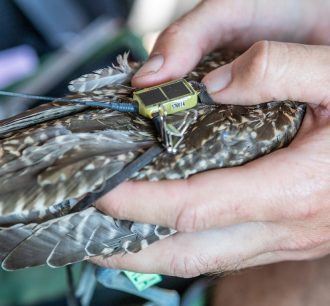
Attaching a “backpack” transmitter to a juvenile Whimbrel. (photo: Alan Kneidel)
Kneidel and colleagues used transmitter data from eight juveniles captured between 2015 and 2022 to track migratory movements and to investigate local movements on Cape Cod and on the non-breeding grounds. They identified stopovers, staging areas, and non-breeding grounds for each bird. Stopovers were defined as rest sites used during migration for periods of time less than one week. Staging areas were defined as rest sites used during migration for one to six weeks. Finally, non-breeding grounds were defined as southern destinations used for extended periods (months to years).
Of the eight tagged juveniles, three stopped transmitting after 2–16 days giving no information about migration but yielding information about local movements in Cape Cod. The other five departed Cape Cod and flew nonstop across the Atlantic Ocean. This means that all southbound birds used Cape Cod as a terminal staging area before flying across the Atlantic to their non-breeding grounds. Two birds stayed at their landfall site throughout the non-breeding season, while another continued to a non-breeding site in Guyana. The final two birds staged in the same place, at Laguna Junca near a Petrochemical Complex in Anzoátegui, Venezuela, after their transatlantic flights. They then continued east along the northern coast of South America where one staged again in Guyana for 15 days before flying about 525 km to its non-breeding grounds in Suriname. The last bird stopped transmitting less than one day after leaving Laguna Juncal and flying 438 km east towards Tobago. One bird was still transmitting as it headed north towards the Flyway of the Americas, a pattern similar to that seen for adult Whimbrel.
Thus, the researchers met their goal of figuring out where the juveniles had gone, or in more scientific terms, they established migratory connectivity between Cape Cod and other sites along the flyway.
The researchers also strove to fill in information gaps about juvenile migration ecology. This sounds simple, but limitations in technology, difficulty of capture, and high juvenile mortality rates have made it challenging. Even though the sample size in this study was small, it gathered a wealth of information, including the first use of tracking data to document a delayed maturation period in a wader. One juvenile Whimbrel spent a year and a half in the British Virgin Islands and another spent two and a half years in Venezuela. This ‘over summering’ has been seen in other species such as Semipalmated Sandpipers Calidris pusilla, where it increased survival enough to compensate for the lost breeding opportunities3. Mounting evidence for extended stays at non-breeding sites emphasizes the importance of this period for the population’s overall health and may impact conservation plans for shorebirds in the southern hemisphere.
Speaking of conservation plans, the researchers had a final goal of establishing a long-term monitoring protocol for juvenile Whimbrel. This study established Cape Cod as a study site in the Western Atlantic Flyway. The tracking data helped the researchers to identify nocturnal roost sites, including Jeremy Point and North Monomoy, used by juveniles and adults. These roosts can now be monitored regularly, and the site is already being used to deploy more tags as the researchers scale up their work tracking juveniles. This will allow them to leverage the opportunity to study adult and juvenile Whimbrel concurrently, as has begun for Eurasian Whimbrel from the population breeding in Iceland N. phaeopus islandicus where researchers have found that juveniles fly non-stop to West Africa like adults, but depart later, travel more slowly, and take less direct routes4.
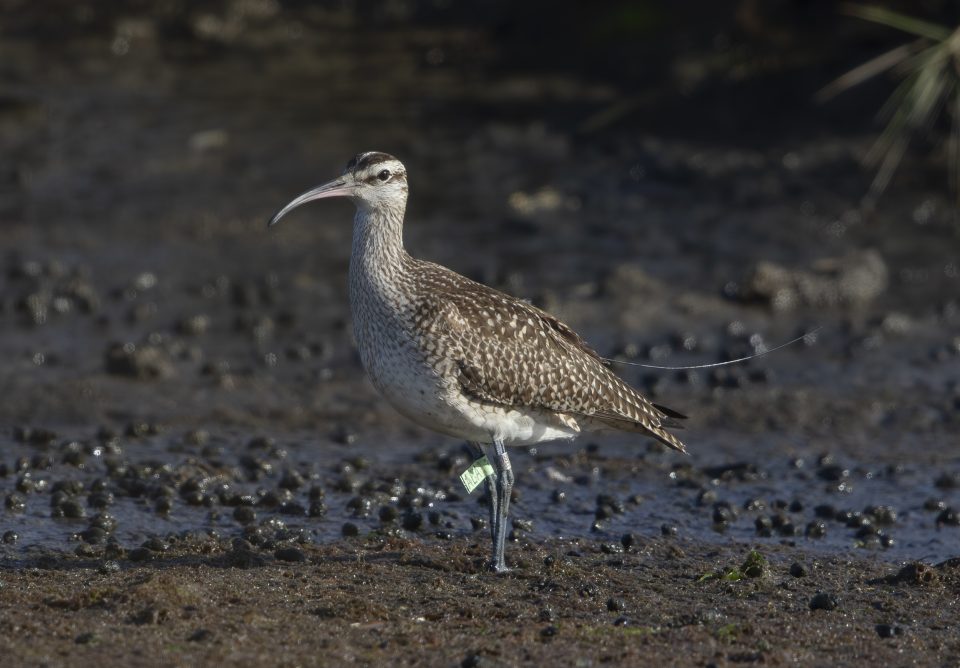
Juvenile Whimbrel wearing a transmitter. Note the antenna. (photo: Brad Winn)
Like most wader species, Hudsonian Whimbrels are in decline5. Their juveniles are facing an increasingly hostile world, destabilised by human-caused climate change, in which is it harder to survive and reproduce. Our teens too are facing instability and a world in which it is increasingly difficult to make a living. It’s no wonder that at recent graduations many teens were opting for a gap year (maybe akin to over-summering). Perhaps this is wise given uncertainly in job prospects (generative AI and economic instability), climate change (floods, fires and melting ice), and political instability. Now, more than ever, it’s important to know where our teens are— both juvenile waders and teenage humans—and to provide them with whatever support we can.
Author’s note: When I first started writing this column, just over ten years ago, I spotlighted a paper about Crab Plover parents. Back then I was searching for affordable and available childcare and was taken by the Crab Plovers innovative approach. Now I am parenting teens and worrying about where they are, and where they’ll go when they fledge. A lot has happened over the past decade, and this column has been a much-needed constant. I hope you have enjoyed reading it as much as I’ve enjoyed writing it.
Deborah M. Buehler
Outreach Editor, Wader Study
1 Kneidel, A.H., L. DiNunzio, S.A. Schulte & B. Winn. 2025. The first tracking data for juvenile Hudsonian Whimbrel. Wader Study 132(2): 110–119.
2 Mehl, K.R., K.L. Drake, G.W. Page, P.M. Sanzenbacher, S.M. Haig & J.E. Thompson. 2003. Capture of breeding and wintering shorebirds with leg-hold noose-mats. Journal of Field Ornithology 74: 401–405.
3 Tavera, E.A., G.E. Stauffer, D.B. Lank & R.C. Ydenberg. 2020. Oversummering juvenile and adult Semipalmated sandpipers in Perú gain enough survival to compensate for foregone breeding opportunity. Movement Ecology 8: 42.
4 Carneiro, C., T.G. Gunnarsson, T. Kaasiku, T. Piersma & J.A. Alves. 2024. Icelandic Whimbrel first migration: Non-stop until West Africa, yet later departure and slower travel than adults. Ibis 166: 715–722.
5 Smith, P.A., A.C. Smith, B. Andres, C.M. Francis, B. Harrington, C. Friis, R.I.G. Morrison, J. Paquet, B. Winn & S. Brown. 2023. Accelerating declines of North America’s shorebirds signal the need for urgent conservation action. Ornithological Applications 125: 1–14.
PDF of this article
Featured image: Juvenile Whimbrel in Cape Cod, Massachusetts, USA. (photo: Alan Kneidel).