
Spotlight: Redshanks overcoming mountains | Wader Study 133(2)
by Deborah Buehler originally published in Wader Study 133(2)
Imagine that you are a small bird who mainly lives on the shore. You weigh about as much as a standard deck of playing cards. While it is cold in the Northern Hemisphere, you are enjoying the winter in the coastal wetlands, mudflats, and marshes of southern Bangladesh. The temperature is warm, and, on the beach at sea level, there is plenty of oxygen to breathe. You are comfortable, but you feel the urge to get to your breeding grounds in India or Tibet. These are high-altitude regions, and you aren’t averse to high altitudes, but you have a problem. There is literally a wall of rock — the Himalayan mountain range — between you and where you need to go.
In this issue of Wader Study, Alton Gwynn Nowell and colleagues present work using GPS trackers to examine Common Redshank Tringa totanus (hereafter Redshank) migration over the Himalayas1. The goal was not to see whether the birds could do it. The fact that Redshanks can migrate over the mountains has been known for some time2. Rather, the researchers wanted to learn more about an understudied population of Bangladesh-wintering individuals and to compare what they do with another population that spends the non-breeding season in Singapore. Both populations migrate over the mountains, but the birds wintering in Bangladesh must contend with them almost as soon as they start migrating north.

Redshank in the mountainous area of Lhasa in the Tibet Autonomous Region. (photo: Chi-Yeung Choi)
Flight over the Himalayas is no small feat. Even with jet engines and pressurized cabins, most commercial airlines do not fly over the world’s highest mountains3. It is dangerous due to unpredictable turbulence and because, if cabin pressure were to be lost, planes need to quickly and safely drop below 3,000 m (10,000 feet), which isn’t possible in the largely unpopulated, high mountains. Birds, however, have been performing trans-Himalayan flight for a long time. Humans first reported this in Bar-headed Geese Anser indicus4, which fly from Mongolia to India and back, over the roof of the world, with just their wings and a little extra body fat.
Redshanks are widespread shorebirds that breed in Eurasia and have a non-breeding range that spans the south of Europe and Asia, as well as Africa and Australia. However, very few populations are thought to cross the Himalayan mountains, and there is limited information on migration behaviour in Central and Eastern Asia, in general. To address this gap in knowledge, Nowell and colleagues focused on birds that spend the boreal winter (October to March) in the estuarine regions in southern Bangladesh and tracked their migration over the Himalayan mountain range to high-elevation wetland breeding grounds in north-west China, Mongolia and Siberia.
The researchers could not simply follow the birds since the mountains present a challenge for birds and humans alike. To find out where the birds were going on their migrations, the researchers captured Redshanks at Nijhum Dwip National Park (on the south-central coast of Noakhali District, Bangladesh) during the boreal winters of 2022, 2023 and 2024. They caught the birds using mist nets (lightweight mesh that humanely captures birds and bats in flight) and attached light-weight, solar-powered GPS-GSM transmitters to healthy birds. .
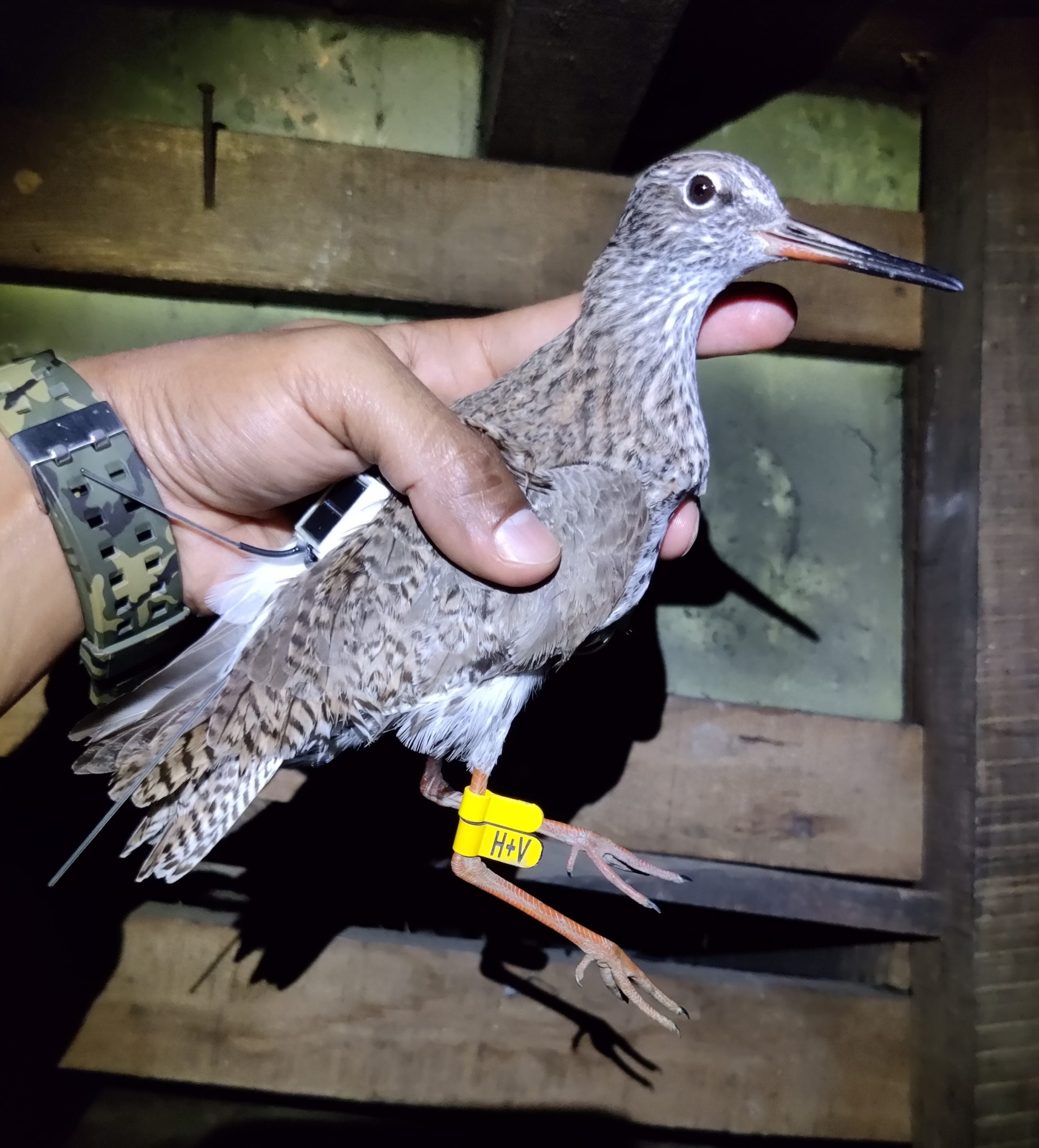
GPS tracker on a Redshank tagged in Nijhum Dwip National Park, Bangladesh. (photo: Nazim Uddin Khan)
Nine of the 14 Redshanks tagged in Bangladesh began their migration north between 2 April and 15 May. Of the nine tracked birds, five spent at least one month in the same location, four on the Qinghai-Tibetan Plateau and one in Central Siberia, indicating these locations as their likely breeding grounds. Interestingly, the breeding sites of three birds were located 50–80 km outside the previously known breeding range, providing new information about important breeding areas for this understudied population of birds. Of the five birds whose tags reported from their breeding grounds, three were also tracked on return migration. For the remaining two birds, the researchers lost the signal and could not determine whether they did not make the journey back, or if their transmitters fell off or stopped working.
In comparison with the population of Redshanks wintering in Singapore, Bangladesh-wintering birds migrated shorter distances, but flew higher, at altitudes generally around 6,000 m above sea level, while Singapore wintering birds stayed at lower altitudes of around 5,000 m. This makes sense because, despite the shorter total distance, the Bangladesh winterers spend a larger portion of their migration over the high-elevation mountains, which they reach almost immediately. There was no overlap in breeding grounds with the Bangladeshi breeding sites in Qinghai province, China and Khakassia, Russia, and the Singaporean sites further south in Tibet, Qinghai and Sichuan provinces1,2. However, the two populations overlapped for part of the migration route across the Himalayas. Stopover sites, defined as places where birds rest and refuel for more than two days without moving over 30 km, were used regardless of where the breeding grounds were, even among birds migrating from Bangladesh. This emphasizes the importance of such sites as likely used by all trans-Himalayan migrants for either stopover or breeding, and the need to conserve them.
Finally, the study sheds some light on which Redshank subspecies cross the Himalayas. The tracking results indicate that Bangladesh-winterers comprise the subspecies T. t. eurhinus, which breeds in the northern part of India and southern Tibet, and the subspecies T. t. ussuriensis, which breeds in Central Russia, but not T. t. terrignotae or T. t. craggi that follow a northeasterly migratory route to breed in eastern Russia and northeast China. This provides an interesting opportunity for comparative studies between subspecies that migrate along the coast versus over the mountains to provide further insights into the ecological trade-offs of high-altitude migration over the Himalayas.
The authors point out that little is known about high-elevation breeding shorebirds compared to Arctic breeders, despite both breeding in extreme environments. Their study, albeit with a small sample size, adds important information about breeding and stopover sites to be conserved. The challenge might not be crossing the Himalayan barrier but rather retaining the sites necessary to do so.
Often, these days, it feels like there is a giant wall of rock between where we are and where we need to be (i.e., climate change, war, politics). Somehow, studies about birds doing insurmountable things bring me hope. This study spotlights small birds able to cross a barrier that deters humans even with our jet engines and airplanes. They endure cold and low-oxygen air to get where they need to go, and they do this twice a year, every year. They survive. They reproduce. Nature has got this life thing figured out. Humans just need to get out of the way.

Flock of Redshanks in Nijhum Dwip National Park, Bangladesh. (photo: Sayam U. Chowdhury)
1 Nowell, A.G., S.U. Chowdhury, M. Foysal, N.U. Khan, W. Qiu, D. Li, X. Lu & C.-Y. Choi. 2026. Shared Himalayan route, distinct origins and destinations: Common Redshank migration in the Central Asian Flyway. Wader Study 133(2): 109–116.
2 Li, D., G. Davison, S. Lisovski, P.F. Battley, Z. Ma, S. Yang, C.B. How, D. Watkins, P. Round, A. Yee, V. Srinivasan, C. Teo, R. Teo, A. Loo, C.C. Leong & K. Er. 2020. Shorebirds wintering in Southeast Asia demonstrate trans-Himalayan flights. Scientific Reports 10: 21232.
3 Simple Flying. 2021. Why do airplanes avoid flying over the Himalayas? YouTube. Accessed on 28 May 2026 at: https://www.youtube.com/watch?v=toiU9Dvd5Yc&t=3s
4 Swan, L.W. 1970. Goose of the Himalayas. Natural History 79, 68–75.