
Links & Sponsors





2026 Santiago de Compostela, Spain
Key Info
Conference Dates
04/09/26 — 07/09/26
The 2026 IWSG conference will take place in Santiago de Compostela (Spain), from September 4-7th, 2026. We will be welcoming you to join us at the Faculty of Biology (https://www.usc.gal/en/center/faculty-biology), located in the Campus Vida of the USC, very close to the urban center of Santiago.
The historic old town of Santiago has been a UNESCO World Heritage Site since 1985, and its cathedral is world-renowned as a major pilgrimage destination on the famous Camino de Santiago. The immense Baroque edifice surrounded in myth is just a 15-minute walk from the train station — a lot shorter than the route many have taken to see it!
If you have questions, please contact the organisers iwsg.conference2026@usc.gal or the IWSG conference coordinator conference@waderstudygroup.org
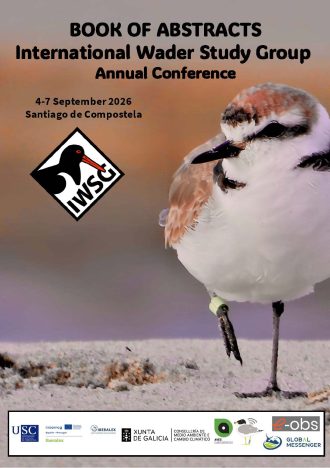
Book of Abstracts (Final_3 September)
Location
SANTIAGO DE COMPOSTELA
For more information about Santiago de Compostela, please visit the Tourism Office Webpage

Welcome to Santiago de Compostela. This virtual gateway takes you to the capital of the Autonomous Community of Galicia; declared a World Heritage City by UNESCO thanks to its monumental beauty, extraordinary conservation and as the final destination of a thousand-year-old pilgrim route: the Way of St. James, which, since the 9th century, has transformed this finis-terrae into a meeting place of Western faith and thinking.
Tradition is still alive as shown by the last Holy Years, which will undoubtedly be the case in the Jubilee year of 2027. The city’s visitors will find its treasures exhibited in sixteen museums as well as the surprising richness of its contemporary architecture, designed by Eisenman, Hedjuk or Siza, surrounded by Galicia’s largest area of parks and gardens.
This setting is alive with cultural expressions – annual music, cinema and theatre festivals, permanent and travelling exhibitions and traditional festivals– organised by the public and private sector, led by the five-hundred-year-old University of Santiago.
These are also joined, throughout the year, by several million visitors. Those who arrive exhausted, motivated by devotion; those who are attracted by the monumental wonders; those who come to participate in language courses or those who choose Compostela as the venue of their professional events: they all end up immersed in the permanent celebration that is the city’s life, especially during the Apostle Festival, declared of International Tourist Interest. Santiago takes care of its visitors by means of a network of hotels with more than 15,000 beds –apart from 5,000 seats available in specialised infrastructures designed for meetings and congresses- and a gastronomic range capable of satisfying those with a discerning palate and all kinds of budgets. No wonder that for more than a thousand years we have been a land of universal reception, a meeting place born for the daily exercising of hospitality.
The University of Santiago de Compostela has been the cornerstone of the city’s and the autonomous region’s education for more than 500 years. Its foundation goes back to 1495, the date when Lope de Marzoa opened the so-called “Estudio Viejo” (Old Study) or “Estudio de Gramática” (Grammar Study) in the Monastery of San Paio de Antealtares. After merging with the Colegio de Santiago Alfeo, founded by Archbishop Fonseca, its first statutes were approved in 1555.
Since then, the University –which originally consisted of the chairs of Art and Theology- has extended its educational field to the more than 180 degrees that are currently imparted in 41 faculties, schools and institutions located throughout the campuses of Santiago and Lugo.
The faculty of Biology is located within Campus Vida, alongside other university faculties and residential colleagues, with direct access to the historic center.


Cíes Islands (Full day) (see links & Media tabs)
Cíes Islands are part of the Maritime-Terrestrial National Park of the Atlantic Islands of Galicia. This archipelago consists of three islands: North or Monteagudo, Middle or Faro, and South or San Martiño. The first two are connected by the sandy beach of Rodas and a breakwater. The Cíes Islands were declared a Natural Park in 1980 and included in the Maritime-Terrestrial National Park of the Atlantic Islands of Galicia, created in 2002, along with Ons Island, Sálvora Island, and Cortegada Island.
Cliffs, shrublands, dunes, and beaches, as well as the various seabeds (rocky, sandy, shelly, etc.), create a large mosaic of ecosystems on these islands and in the surrounding waters. This diversity of environments provides habitat for a great number of species: more than 200 types of algae, among which many fish and molluscs find shelter and breeding grounds; seabirds that nest on cliff ledges and fish in shallow waters; plants surprisingly adapted to living among dune sands or in the narrow crevices of cliffs. The small size of the archipelago makes it possible to explore the islands on foot, using the existing network of paths. All of them lead to lighthouses located in prime spots for birdwatching. The conservation of these natural values is a challenge in which we must all take part.
Maritime-Terrestrial National Park of The Atlantic Islands

Ortigueira-Estaca de Bares (Full day) (see links & Media tabs)
Atlantic estuary of importance for the wintering of waterbirds. It is a wetland of international importance (RAMSAR) and forms part of Natura 2000 (SPA and SAC).
Its outer section, with deep waters, is characterized by beaches and rocky cliffs. Its inner section, sheltered and shallow, comprises intertidal plains covering just over 1,000 hectares, extensive brackish marshes, and a 3-kilometer beach with fixed dunes.
Cape Estaca de Bares is the northernmost point of the Iberian Peninsula. It is a strategic location for observing the postnuptial migration of seabirds, mainly between late August and late September. This cape separates the estuaries of O Barqueiro and Ortigueira.

Route within the City Walls: Monumental City (Half day) (see links & Media tabs)
A tour around Santiago de Compostela’s monumental heritage, including the Cathedral and the famous Plaza del Obradoiro, as well as the main monuments and squares. This route also features other corners, monuments, squares… some of which are unknown to visitors and omitted by guidebooks but should not be overlooked.
Cathedral rooftops includes two consecutive guided tours: the Archbishop’s Palace of Gelmírez and going up to the church’s rooftops. At an altitude of almost 300 metres, 30 metres above Plaza del Obradoiro and with a 360-degree field of view.

Workshops will be held on Friday the 04th of September
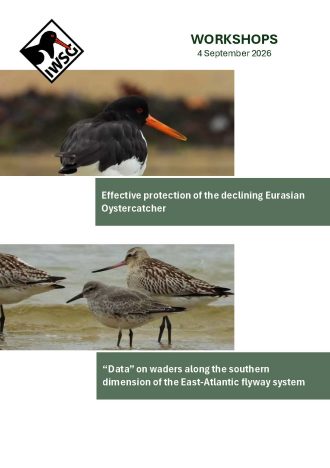
Workshops Program
- Effective protection of the declining Eurasian Oystercatcher
Organizers: Bruno Ens (Stichting Onderzoek Scholeksters (SOS), Andrew Hoodless, Mike Short, Lizzie Grayshon and Rosa Hicks (Game & Wildlife Conservation Trust), Dominic Cimiotti and Jolina Kröger (Michael Otto Institute of NABU) and Roos de Vries (Vogelbescherming Nederland).
In many parts of Europe, both breeding and wintering populations of the Eurasian Oystercatchers have been on the decline since the 1980s. For instance, in the Netherlands more than 70% of the breeding population was lost since 1985 and around 60% of the wintering population.
In 2007 an IWSG workshop on the conservation status of the 11 surviving Oystercatcher species around the world was organized in La Rochelle. The results were published in issue 20 of International Wader Studies (Ens and Underhill 2014). This included an assessment of the conservation status of the Eurasian Oystercatcher (van de Pol et al. 2014).
Much has happened since 2007. In many parts of Europe, the decline has continued, but there are some notable exceptions. There has also been new research on the threats to the population, the causes of the decline and new conservation measures, like land management, lethal and non-lethal predation management options to improve breeding success and adoption of beach-nesting bird monitoring schemes to reduce recreational disturbance. We think it would be useful to bring this information together to come to a European plan for effective conservation of the Eurasian Oystercatcher.
- “Data” on waders along the southern dimension of the East-Atlantic flyway system
Organizers: Ulf Bauchinger (LIFE Godwit Flyway), Alain Maasri (LIFE IP GrassBirdHabitats) and Erik Kleyheeg (AEWA).
Many initiatives have been launched on different levels, and many do share the common goal of conservation and protection of wildlife and people. Such initiatives range from regular bird ringing camps to continent wide wetland counts, from single person observations to university programmes, from private initiatives to large transnational projects. We promote here a flyway-based initiative on wader species that bridges between these efforts with special focus on improving our understanding on the African dimension of the East Atlantic flyway system.
This workshop is tailored to address the different aspects related to data in the broadest sense. This entails biotic and abiotic data that range from data on wader habitats, over wader populations to behaviour on the level of population as well as on the level of the individual. What are the needs for and the gaps in scientific understanding and conservation measures? This workshop aims to generate resources that can be made available through our institutional websites (IWSG, AEWA, LIFE IP GrassBirdHabitats, LIFE Godwit Flyway) like protocols, videos, templates and manuals for the use of the individual to organisations. We also aim that this workshop will represent the first of a sequence of workshops that will be continued yearly as workshop at the IWSG meeting.
Located in the northwest of Spain, Santiago de Compostela is well-connected and can be easily accessed by plane, train or coach, with direct flights from major European cities, including London, Paris, Brussels, Frankfurt, Dublin, Milan, or Zurich, and many more connections via Madrid or Barcelona. The airports of A Coruña (Alvedro), Vigo (Peinador), and Porto (Francisco Sá Carneiro) are only a stone’s throw from Santiago de Compostela and may also be convenient options. In addition, there is a high-speed train which reaches our city from Madrid in 3 hours.
Getting to Santiago by train
There are several direct trains which daily connect Santiago de Compostela with Madrid, Barcelona and Vitoria Gasteiz. With a connection in Madrid or Ourense, you will also be able to reach Santiago from many other Spanish cities (e.g. Alicante, Córdoba, Sevilla, Toledo, Valladolid, or Zaragoza). If you arrive from Porto (Portugal), you will have to change trains at Vigo train station. Trains are operated by Renfe, the national railway company. You may consult their website for further information on timetables and fares.
Getting to Santiago by coach
If you landed at Madrid (Adolfo Suárez Madrid-Barajas) or Porto (Francisco Sá Carneiro) airport, you could also reach Santiago by coach. The journey from Madrid airport takes approximately 9 hours (Alsa is the company which provides the service) and 3 hours and 30 minutes from Porto Airport (Alsa or Flixbus). In addition, Flixbus and Alsa connect Santiago with major European cities, such as Berlin, Lisbon, Milan, Paris, or Prague. You may consult their websites for information on timetables and fares.
From the Santiago airport
By Taxi
A taxi ride from the airport to the city center will take 15-20 minutes and should cost € 23.00 (24h fixed fee). https://radiotaxicompostela.com/tarifas/
By Airport bus
Every half hour a bus leaves from Santiago de Compostela Airport to the Railway Station located south of the center and vice versa. Buses operate every day of the week. During the tour several stops are available, one of them at the Plaza de Galicia located in the city center. The duration of the journey from the first bus stop located in front of the terminal to the Railway Station is about 35 minutes. Tickets are on sale with the bus driver. A single ticket costs € 1.-.
For this year’s conference, you will have to book your accommodation by yourself.
Santiago de Compostela offers a wide range of accommodations for all budgets, including 5-star hotels, apartments, youth hostels, and university student halls. Additional information will be provided soon. In the meantime, please visit the accommodation website run by the Santiago de Compostela’s Tourist Information Office to find out about different accommodation options.
The call for IWSG conference grant 2026 is closed
—————————————————
Other Financial Support Opportunities
We are pleased to announce that BOU Member Conference Attendance Grants are now available to support attendance at IWSG conferences.
Applicants must be members of the British Ornithologists’ Union (BOU) and must fulfil the eligibility criteria set by BOU. Applications for this support are made independently through the BOU.
🗓 Next application deadline: 26 May 2026
Full details, eligibility criteria, and application instructions are available here: click the link
Location of Faculty of Biology
Google Maps: Facultade de Bioloxía – USC
881 81 32 45
Illas Cíes
Google Maps: Illas Cíes
National Park of the Atlantic Islands of Galicia: https://illasatlanticas.gal/en/inicio
Ría de Ortigueira and Cape Estaca de Bares
Google Maps: Ría de Ortigueira y Ladrido
Google Maps: Cabo Estaca de Bares
Birding Estaca de Bares: https://www.birdingplaces.eu/es/birdingplaces/spain/estaca-de-bares
Ría de Ortigueira: ria-de-ortigueira-carino-estaca-de-bares
Catedral de Santiago
Google Maps: Catedral de Santiago de Compostela
Dinners
Google Maps: Dinner 4 September. Pazo Fonseca
Google Maps: Dinner 5 September. Mercado La Galiciana
Google Maps: Dinner 6 September. Pazo San Lourenzo